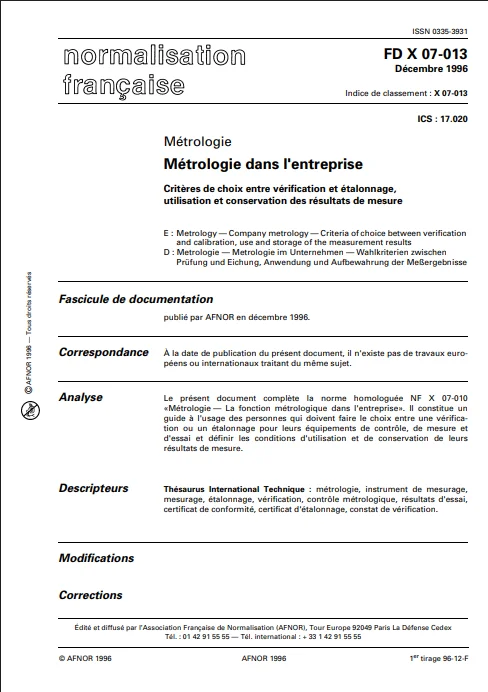
Understanding FD X 07-013
FD X 07-013 is a French guidance document (fascicule de documentation) published by AFNOR in December 1996. It complements the parent standard NF X 07-010 by providing criteria for choosing between calibration and verification of measurement equipment, and guidance on exploiting and storing measurement results.
Scope and Application
FD X 07-013 applies to all measurement equipment in an industrial fleet used to demonstrate conformity to a specification (per ISO 10012-1), including equipment used for testing, inspection, and production. This includes:
- All measurement equipment requiring a metrological operation (calibration or verification)
- All measurement results from periodic calibration and verification operations
- Equipment used as reference standards in traceability chains
- Any organization where measurement accuracy affects conformity to specifications
The document works alongside FD X 07-011 (verification aspects), FD X 07-012 (calibration aspects), and FD X 07-015 (traceability).
Core Principles
Equipment Criticality: Organizations must determine which equipment critically influences product quality using a structured decision flowchart.
Calibration vs Verification: The choice between calibration and verification depends on whether numerical corrections are needed, the confidence ratio, and the intended use of results.
Measurement Traceability: All critical measurement equipment must be traceable to recognized standards through documented calibration chains.
Result Exploitation: Calibration and verification results must be actively used to prove fitness for use, track drift, modify intervals, and evaluate the impact of out-of-tolerance instruments.
Record Retention: Calibration certificates, verification results, and raw data must be retained according to defined quality assurance procedures with documented retention durations.
Key Requirements of FD X 07-013
1. Equipment Classification and Identification
Organizations must classify and manage their measurement equipment fleet by:
- Building a hierarchy of measurement equipment by criticality level
- Classifying equipment by hierarchical type, usage category, and mode of use
- Identifying and marking all equipment with codes recorded in equipment life records (fiche de vie per NF E 10-022)
- Designating competent personnel with authority to select metrological operations
2. Critical Equipment Determination
The document provides a decision flowchart to determine which operations apply:
- Step 1: Does the equipment critically influence product quality?
- Step 2: Is the equipment a measuring instrument or test means?
- Step 3: Does use of the instrument require corrections from calibration data?
- Non-critical equipment requires only inventory management
- Test means without measuring instruments require comparison to a reference or technical standard
3. Choosing Between Calibration and Verification
Calibration is recommended when numerical corrections with uncertainty are needed, when the confidence ratio is insufficient (should be greater than 4), when monitoring drift, or when the instrument serves as a reference standard. Verification is recommended when:
- Only conformity to predefined acceptance limits is needed
- No numerical results need to be exploited
- Interchangeability of measuring instruments must be ensured
- The user only needs authorization for return to service
4. Calibration and Verification Results
Calibration produces numerical results with associated measurement uncertainty, materialized as a calibration certificate per FD X 07-012. Verification produces a conformity judgment materialized as:
- A verification report per FD X 07-011
- A calibration certificate followed by a conformity judgment
- A validation mark (stamp, label, or life record entry)
5. Exploitation of Measurement Results
Results must be actively used to prove fitness for use, demonstrate metrological traceability, reduce measurement errors through corrections, track drift, modify calibration/verification intervals, evaluate out-of-tolerance impact on previous measurements, and authorize return to service with appropriate markings.
6. Documentation and Record Retention
Quality assurance procedures must govern record retention:
- Calibration certificates and raw data must be retained in full
- For verification, only out-of-specification points need retention if a formal report exists
- Records must be indexed for orderly storage and rapid retrieval
- Retention duration is determined by QA requirements, intervals, accreditation validity, and audit periodicity
- Documented procedures must specify location, form, responsible person, duration, and disaster recovery
How ATEK Supports FD X 07-013 Compliance
ATEK’s environmental monitoring platform provides the metrological infrastructure required by FD X 07-013.
Factory-Calibrated Sensors
Every ATEK sensor is factory-calibrated with NIST traceability before shipment. Customers receive:
- Calibration certificates documenting the metrological traceability chain
- Measurement uncertainty specifications at calibration points
- Environmental conditions during calibration
- Identification of calibration standards used
- Clear documentation of equipment identity and specifications
This calibration documentation establishes the measurement traceability required by FD X 07-013 Section 5.
Measurement Uncertainty Management
ATEK provides complete measurement uncertainty specifications:
- Calibration uncertainty at specified temperature and humidity points
- Repeatability characteristics of sensors
- Long-term stability and drift specifications
- Temperature coefficient effects
- Hysteresis and other systematic uncertainties
These specifications enable organizations to evaluate total measurement uncertainty in their applications, fulfilling FD X 07-013 Section 4.5 requirements for calibration results with associated uncertainty.
Automated Calibration Tracking
The ATEK platform tracks calibration dates and maintenance schedules:
- Automatic alerts when sensors are due for recalibration
- Historical records of all calibrations and verifications
- Integration with maintenance schedules
- Export of calibration history for audits
This automation ensures equipment never goes out of calibration unnoticed, supporting FD X 07-013 Section 5 requirements for modifying calibration and verification intervals based on drift analysis.
Continuous Equipment Verification
ATEK’s real-time monitoring provides continuous verification that equipment remains within specification:
- Automated drift detection identifying sensors that are drifting out of specification
- Quality control alerts if measurements deviate from expected ranges
- Redundant sensors for measurement comparison and validation
- Historical data trending to identify degradation patterns
This continuous verification approach goes beyond periodic calibration to provide confidence that equipment performs reliably throughout its operational life.
Complete Record Management
ATEK’s cloud-based platform automatically maintains comprehensive metrological records:
- Every measurement logged with sensor ID, timestamp, and environmental conditions
- Complete calibration certificate chain stored securely
- Audit trails showing all system activities and data access
- Unlimited retention capability for long-term compliance
- Export capabilities for regulatory inspections and audits
These automated records fulfill FD X 07-013 Section 6 requirements for record retention, storage, and retrieval of calibration and verification results.
Process Control Integration
ATEK measurement data integrates seamlessly with process control systems:
- Real-time monitoring with automated alerts for out-of-specification conditions
- Historical data for trend analysis and process improvement
- Environmental data supporting product traceability
- Integration with quality management software
This integration ensures that measurement activities contribute directly to process control and product quality assurance.
Implementation Strategy
Phase 1: Assessment and Planning
Begin by assessing your current measurement activities:
- Identify all measurement equipment used to verify product or process quality
- Evaluate current calibration practices and traceability documentation
- Determine measurement uncertainty requirements for critical processes
- Define record retention requirements based on applicable regulations
Phase 2: Equipment Qualification
Establish your ATEK monitoring system with proper qualification:
- Conduct installation and operational qualification
- Document sensor specifications and calibration traceability
- Establish baseline measurement uncertainty
- Define environmental monitoring requirements
Phase 3: Process Integration
Integrate ATEK sensors into your quality processes:
- Configure real-time monitoring and alerting
- Establish calibration schedules and maintenance procedures
- Link measurement data with product traceability records
- Train staff on metrological procedures and documentation
Phase 4: Verification and Documentation
Verify compliance with FD X 07-013 requirements:
- Confirm measurement traceability through calibration chains
- Document metrological function organization and responsibilities
- Establish procedures for metrological confirmation and control
- Create compliance documentation for audits
Sustaining FD X 07-013 Compliance
ATEK makes it simple to maintain compliance over time through:
- Automated Calibration Tracking: Never miss a recalibration interval
- Continuous Verification: Real-time monitoring ensures equipment remains in specification
- Complete Record Keeping: All metrological activities automatically documented
- Regulatory Readiness: Export comprehensive compliance reports for inspections
By establishing metrological management as an ongoing process rather than a point-in-time activity, organizations using ATEK achieve sustained compliance that protects product quality and regulatory standing.