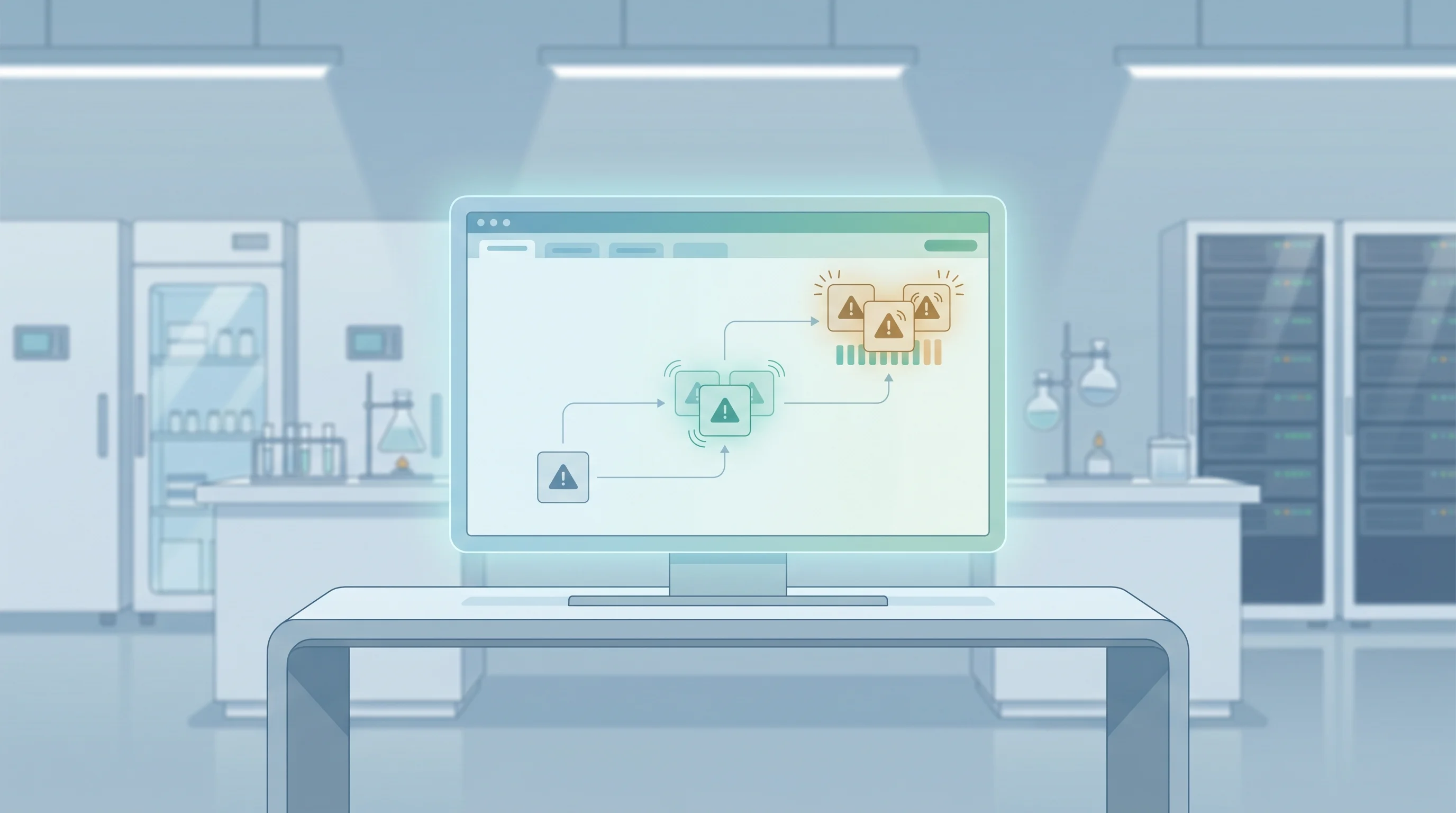

The Hidden Cost of Noisy Alarms
In regulated critical environments such as laboratories, hospitals, and pharmaceutical cold chains, continuous monitoring is essential. However, when environmental monitoring systems generate an excessive volume of alerts—often for minor, transient, or non-critical deviations—operations leaders and facilities managers face a significant operational threat: alarm fatigue.
Alarm fatigue occurs when staff become desensitized to safety alerts due to sheer volume. The causal chain is straightforward: too many non-actionable alerts lead to delayed acknowledgements, which leads to missed or ignored critical alarms. Over time, this erodes response discipline and compromises audit readiness.
Engineering Discipline Through Escalation Workflows
Restoring urgency requires a structured approach to alarm management. ATEK provides real-time alerts and configurable escalation workflows designed specifically to help Canadian life-science operations maintain compliance and protect critical assets. Instead of treating all alerts equally, facilities must implement a tiered response system based on operational impact.
Key Components of an Effective Escalation Plan
- Configurable Delay Settings: Implement short delays for alerts that might resolve automatically (e.g., a refrigerator door temporarily ajar). This filters out transient noise without suppressing genuine deviations.
- Strict Acknowledgement Expectations: Define clear standard operating procedures (SOPs) dictating who must respond and within what timeframe. Unacknowledged alerts must never be dismissed without an audit trail.
- Tiered Escalation: If the primary contact fails to acknowledge a critical alert within the designated timeframe, the system must automatically escalate the notification to a secondary responder or management layer.
- Root-Cause Review: Do not just silence the alarm. Every persistent or critical alert should trigger a documented root-cause analysis to correct the underlying environmental or mechanical failure.
Decision rule: An environmental alert must only trigger an immediate, high-priority notification if the measured parameter crosses a validated, scientifically justified threshold that directly threatens product stability, sample integrity, or patient safety. All other deviations should follow a staggered delay and escalation protocol.
Continuous Improvement Through Rationalization
Designing an effective system is not a one-time exercise. As facility operations evolve, so do the baseline environmental parameters. Implementing a periodic alarm rationalization process ensures that setpoints, delay configurations, and escalation paths remain strictly aligned with current operational realities.
Caveat: Simply widening temperature or humidity tolerances to reduce alarm frequency will trigger audit findings and compromise regulatory compliance. Rationalization must focus on optimizing system configurations and eliminating redundant sensors, never at the expense of environmental accuracy.
By continuously refining these workflows, quality teams can ensure that when an alarm sounds, it demands—and receives—immediate, disciplined action.