
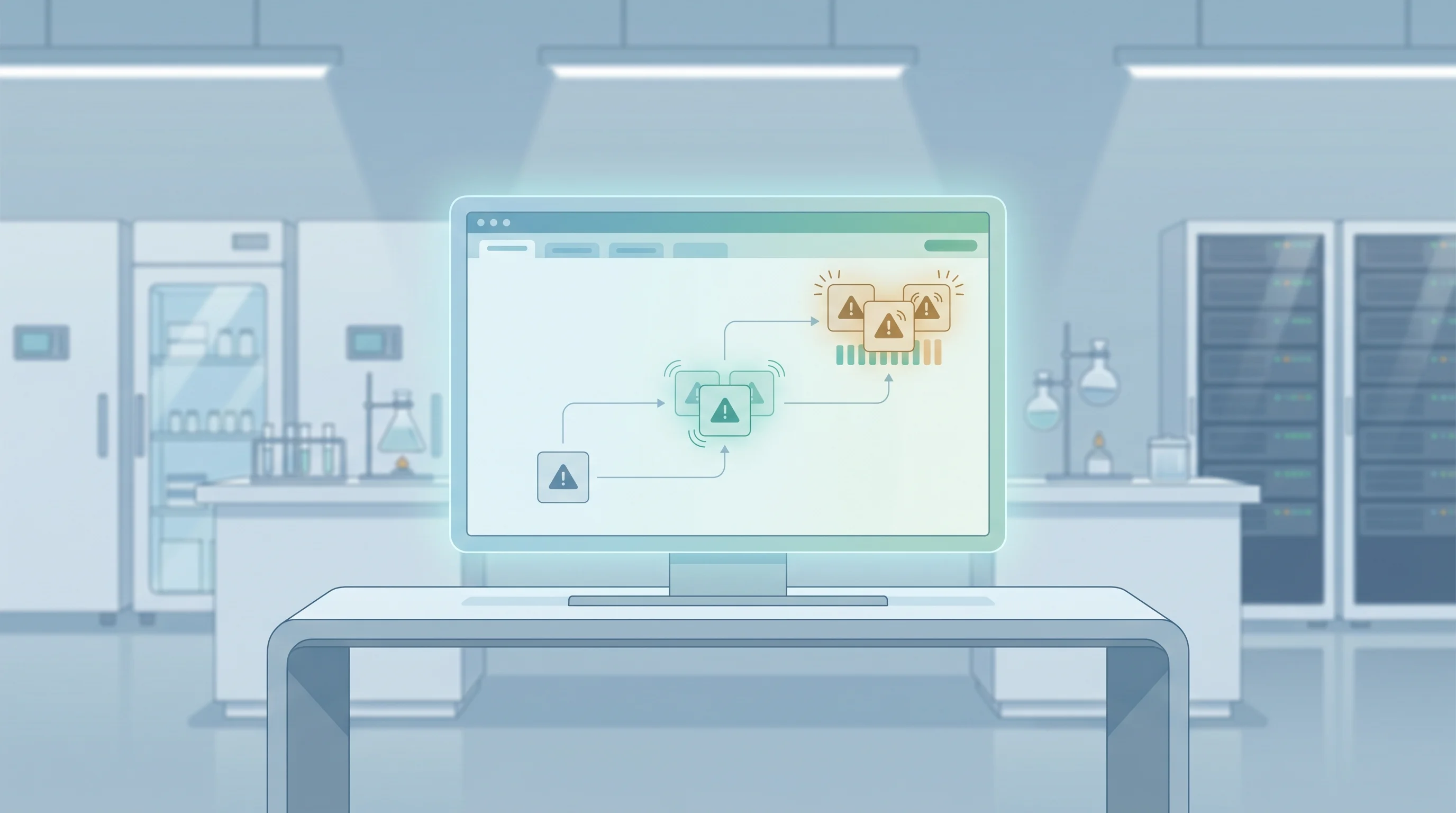
Alarm Fatigue Usually Starts as a Reasonable Adaptation
Alarm fatigue is easy to describe as a people problem: operators ignore too many alerts, acknowledgements get late, and the one alarm that mattered is buried in noise.
That explanation is usually too shallow. In an environmental monitoring system, staff learn from the system you give them. If a refrigerator door opening for 45 seconds, a compressor recovery cycle, a momentary humidity bump, and a genuine cold-room failure all arrive with the same urgency, the system is training people that alarms are not decision signals. They become interruptions.
The wrong goal is “fewer alarms.”
The useful goal is a higher ratio of actionable alarms to total alarms. That distinction matters because a quiet system can be unsafe if it hides slow deviations, and a noisy system can be unsafe if it teaches staff to wait before responding.
The Hidden Failure Mode: Detection Without a Response Contract
An environmental monitoring platform can detect a deviation correctly and still fail operationally. Detection is only the first half of the control loop. The second half is the response contract:
- Who is expected to acknowledge?
- How quickly do they need to acknowledge?
- What does acknowledgement mean?
- When does the case move to the next person?
- What evidence will exist after the event is closed?
Failure mode: an alarm is acknowledged only to stop the noise.
That acknowledgement does not prove the product, sample, room, incubator, freezer, or pressure cascade was protected. It proves only that someone clicked a button, answered a call, or silenced a notification. If the system does not require a response state, the audit trail can look active while the actual investigation remains vague.
Better model: every alarm should have a documented decision window and a documented next action. The action can be small, but it has to be real: local check started, maintenance contacted, quality notified, product assessed, no impact with rationale, or alarm configuration reviewed.
Separate Three Kinds of Alarm Noise
Not all noisy alarms have the same cause. Treating them as one category leads to bad tuning.
1. Transient Process Noise
Example: a cold room temperature blips during a door opening or compressor transition, then returns to range before any meaningful product risk develops.
Wrong fix: send the same high-priority notification every time the blip occurs.
Better rule: use a delay that reflects the equipment behavior and the time-to-risk. The delay should filter events that self-correct before they matter, while still leaving enough time for human response before the condition becomes a deviation.
2. Chronic Equipment or Facility Noise
Example: the same storage area alarms every week because a seal is failing, an evaporator is icing, an HVAC schedule changed, or staff loading patterns no longer match the original assumptions.
Wrong fix: keep increasing the delay until the alarm stops bothering people.
Better rule: treat repeated alarms as a maintenance or process signal first. Threshold and delay changes should happen only after the team asks whether the equipment, sensor, placement, calibration, or operating practice changed.
3. Organizational Noise
Example: the alarm is valid, but the contact list is stale, the primary responder is not on shift, the escalation window does not match actual coverage, or the same person receives every category of alert.
Wrong fix: blame the responder for late acknowledgements.
Better rule: align notification paths to the staffing model. A 10-minute acknowledgement window is not a control if no trained person is assigned to receive and act on it at that time.
For private clinics, pharmacies, and smaller labs, the fastest improvement is often not a new enterprise program. It is a focused rollout that locks down the first monitored assets, contact list, acknowledgement window, and escalation path. ATEK’s fast-start deployment path is built around that operational sequence.
Design Escalation Rules as Timers, Not Suggestions
Escalation should not depend on somebody noticing that an alarm has been sitting too long. The system should move the case forward automatically.
A practical escalation rule has four fields:
- Condition: the monitored state that started the alarm.
- Delay: how long the condition must persist before notification.
- Acknowledgement window: how long the primary responder has to take ownership.
- Escalation path: who receives the alarm next if ownership does not happen.
Incorrect setup: “Notify operations, then quality if needed.”
Correct setup: “Notify the on-call operations contact after the condition persists for the configured delay. If there is no acknowledgement within the facility-defined window, notify the quality or team lead contact automatically. Continue escalation for sustained critical conditions until a responsible person owns the event.”
The difference is not wording. The first rule is a hope. The second rule is executable.
Acknowledgement Should Mean Ownership, Not Silence
The acknowledgement step is where many alarm workflows lose meaning.
Risky example: the only available action is “acknowledge.”
When that is the whole workflow, the platform cannot tell the difference between “I am walking to the freezer now,” “I saw it but cannot respond,” and “This is probably another nuisance alarm.”
Better acknowledgement states:
- Investigation started: a trained person has taken ownership.
- Local check required: someone must physically inspect the asset or room.
- Maintenance required: the event points to equipment or facility intervention.
- Quality assessment required: stored material, sample integrity, or batch status needs review.
- No impact, rationale documented: the condition was verified and does not require corrective action.
These states do not replace the SOP. They make the SOP visible in the record.
Delay Settings Should Be Based on Time-to-Risk
Delay settings are often tuned for comfort: “this alarm is annoying, so make it wait longer.” That is backwards.
The better question is: how long can this condition persist before it creates a material risk, and how long does the team need to respond?
Illustrative decision rule:
| Situation | Bad configuration | Better configuration logic |
|---|---|---|
| Short door opening on a loaded cold room | Immediate critical alarm | Delay long enough to filter normal access, short enough to preserve response time |
| Slow temperature drift after business hours | Long delay because it is “not urgent yet” | Earlier notification if no one is present to observe the trend |
| Differential pressure excursion in a controlled area | Same rule as a storage fridge | Rule based on room use, pressure cascade importance, and investigation requirement |
| Repeated alarm on the same asset | Longer delay every month | Root-cause review before changing the alarm rule |
This is why escalation design belongs in quality, facilities, and operations together. Quality owns the risk interpretation. Facilities understands the equipment behavior. Operations knows who can actually respond.
Use Alarm Rationalization Before You Tune the System Quieter
Alarm rationalization is the disciplined review of alarm points, thresholds, delays, recipients, and escalation rules. It is not a cosmetic cleanup of the dashboard.
For each recurring alarm, ask four questions in this order:
- Is the alarm necessary? If the condition does not require action, why is it configured as an alarm?
- Is the threshold valid? Does it reflect process risk, product requirements, room use, or equipment limits?
- Is the delay valid? Does it filter transient noise without consuming the response window?
- Is the escalation valid? Does the next person in the chain have authority, training, and coverage to act?
Only after those questions should the team change a threshold or delay.
Failure mode: the review meeting focuses on alarm count alone.
Better review artifact: a short log that records the alarm, likely cause, action taken, and whether the fix was equipment, operations, sensor, threshold, delay, recipient, or SOP-related. Over time, that log tells you whether the monitoring system is improving or just being muted.
What an Auditor or Quality Reviewer Can Actually See
Alarm fatigue becomes a compliance problem when the record cannot explain what happened.
A healthy alarm history should show:
- The condition that triggered the alarm.
- The delay and escalation rule that applied.
- The person or role notified first.
- The acknowledgement time.
- The escalation path if the first responder did not acknowledge.
- The response state or closure rationale.
- Any repeated-event action, such as maintenance, sensor review, threshold review, or SOP update.
Weak record: “Alarm acknowledged.”
Stronger record: “Temperature excursion acknowledged by operations, local check started, door found ajar, temperature recovered within assessed window, quality reviewed no product impact, repeated door alarm added to weekly operations review.”
The stronger record is not longer for its own sake. It preserves the decision chain.
A Simple Escalation Design Checklist
Use this checklist when reviewing environmental monitoring alarms:
- Alarm purpose: what decision should this alarm force?
- Risk owner: who decides whether the event affects product, samples, animals, room classification, or operations?
- First responder: who can physically or operationally act first?
- Acknowledgement window: how long before lack of ownership becomes its own problem?
- Escalation timer: what happens automatically when that window expires?
- Closure requirement: what must be recorded before the event is closed?
- Repeat trigger: how many repeats cause review of equipment, sensor placement, threshold, delay, or SOP?
If one of those fields is blank, the alarm is not fully designed yet.
Preserve Urgency by Being Precise
The purpose of alarm management is not to make monitoring quieter. It is to make urgent alarms believable again.
That requires precision in three places:
- Filter transient noise with delay settings tied to equipment behavior and time-to-risk.
- Turn acknowledgement into documented ownership, not a silence button.
- Make escalation automatic, timed, and aligned to real staffing coverage.
Alarm fatigue fades when the monitoring system stops asking people to interpret noise and starts giving them clear decisions. In regulated environmental monitoring, that clarity is not just operational hygiene. It is part of the control system.