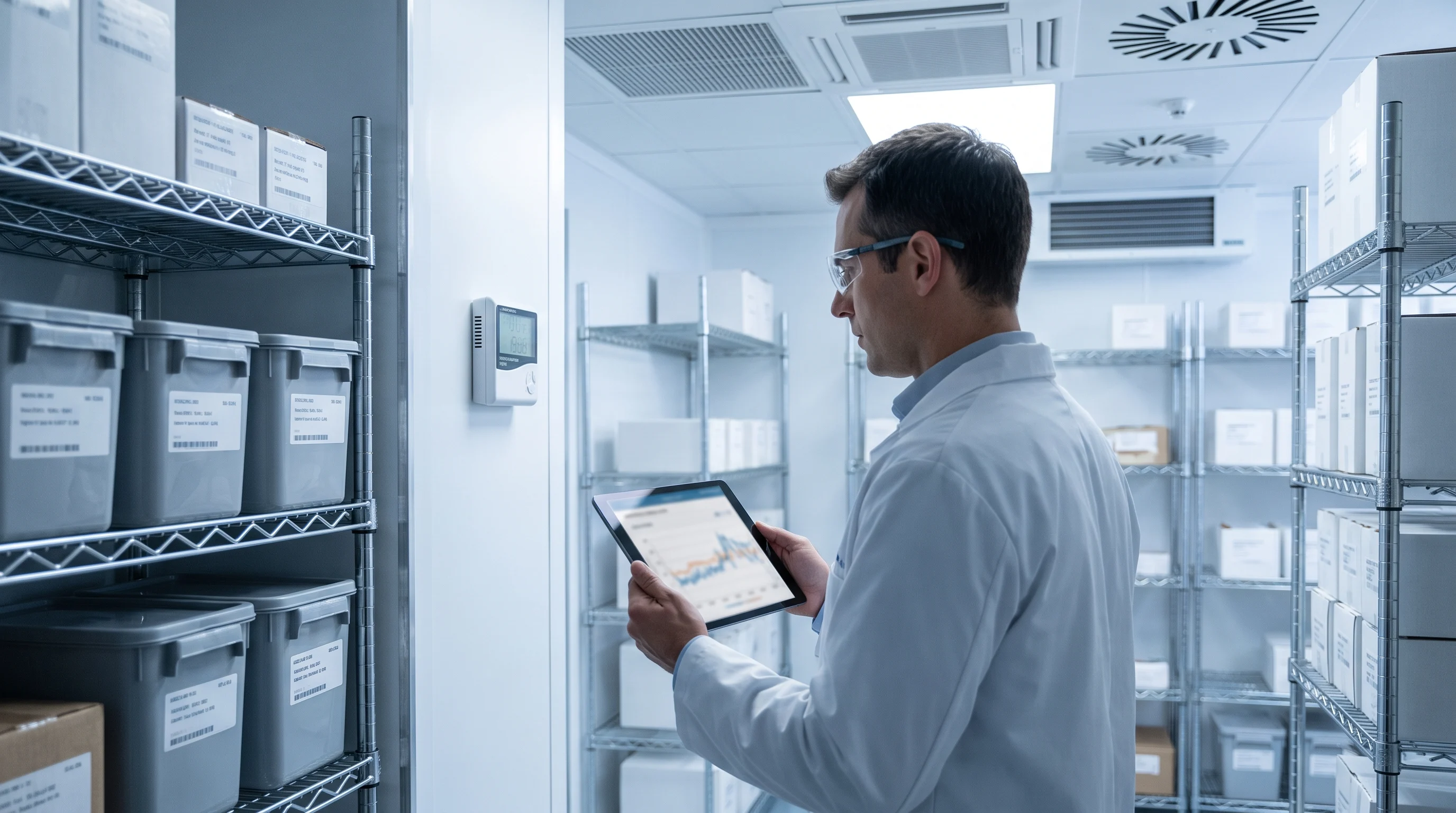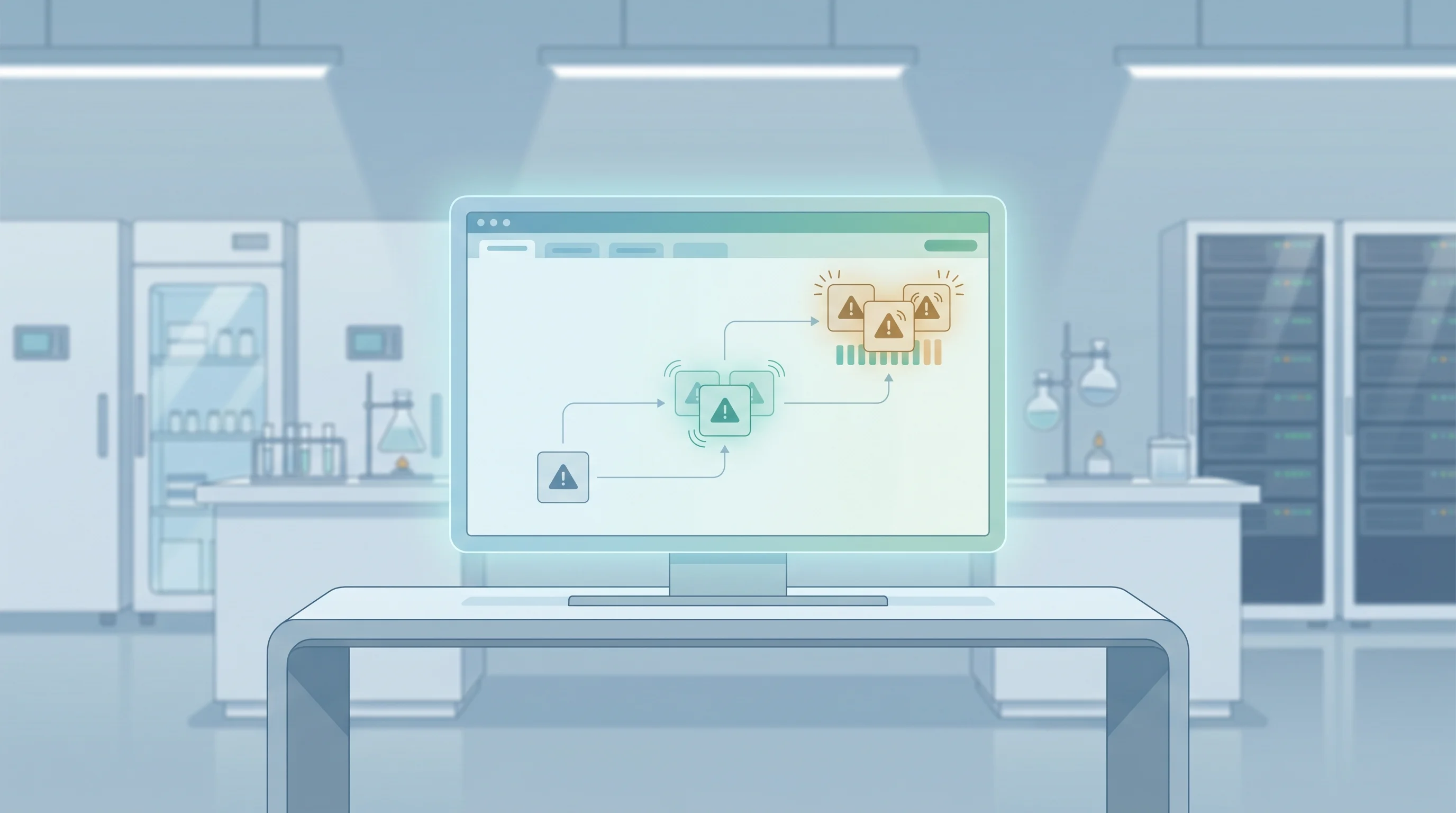

Your -80°C freezers are only as safe as the room they sit in. When the air conditioning fails on a Friday night and the room climbs to 35°C over the weekend, every compressor in that room is fighting a battle it wasn’t designed to win. Room temperature monitoring is the earliest warning you’ll get - and the cheapest insurance against catastrophic sample loss.
This article covers why ambient temperature matters more than most labs realize, the three scenarios that cause HVAC failures in freezer rooms, and the layered defense strategy that protects critical research infrastructure.
-80 Freezers Are Critical Infrastructure
A data center without room temperature monitoring is unthinkable. The servers inside are too valuable, too sensitive to heat, and too expensive to replace. Yet freezer rooms - housing biological samples that are literally irreplaceable - routinely operate without ambient monitoring.
ULT freezers are rated for ambient temperatures between 15°C and 32°C (Thermo Fisher, Eppendorf, PHCbi). This isn’t a suggestion. It’s the operating envelope. Outside this range, the compressor cannot maintain the setpoint.
How bad does it get? NIH testing showed that ULT freezers operating above 32°C ambient in unmaintained conditions produced cabinet temperatures 12.5°C warmer than the setpoint (Gumapas & Simons, 2013, ASHRAE Journal). A freezer set to -80°C running at -67.5°C is not storing your samples safely.
The U.S. Department of Energy recommends maintaining ULT freezer rooms at 18-21°C (DOE Better Buildings ULT Freezer User Guide). That’s not room temperature for comfort - it’s room temperature for compressor efficiency.
The Real Cost of Each Degree
Each 1°C rise in ambient temperature increases ULT freezer compressor energy consumption by approximately 2-4%, based on cascade refrigeration coefficient of performance research (Dopazo et al.) and established industrial refrigeration engineering principles (ASHRAE).
That percentage sounds small until you do the math:
- At 25°C ambient vs. the recommended 20°C, each freezer consumes 10-20% more energy
- In a room with 15 ULT freezers, that’s a significant increase in both electricity cost and heat output
- Every watt the compressor uses becomes heat rejected into the room
- More compressor work produces more heat, which raises room temperature, which forces more compressor work
This is a thermal feedback loop. In a well-cooled room, it’s manageable. Without adequate HVAC, it’s a runaway condition.
When HVAC Fails: The Three Scenarios
HVAC failure in a freezer room isn’t always dramatic. Sometimes it’s subtle, predictable, and entirely preventable - if you’re monitoring.
Heatwaves
Extended outdoor temperatures above 35°C push rooftop HVAC units to their limits. The cooling system may run at full capacity and still not keep the freezer room below 25°C. During multi-day heatwaves, the cumulative thermal load can exceed the HVAC system’s design capacity. For a deeper look at protecting ULT freezers during extreme heat, see our guide on ULT freezer protection during heatwaves.
Between-Season HVAC Adjustments
Facilities transition from heating to cooling mode every spring and fall. During the changeover window, cooling may be reduced, temporarily offline, or misconfigured. Building management systems may not prioritize the freezer room during transitions. The freezer room doesn’t get a season break - it needs cooling year-round, even in January, because the freezers themselves generate heat constantly.
Weekend Energy Saving
This is the most common scenario and the most preventable.
Building technicians or automated BMS schedules reduce HVAC output over weekends. The logic is simple: nobody is in the building, so reduce energy use. But the freezers are in the building, running 24/7, rejecting heat into a room that’s no longer being cooled adequately.
By Monday morning, the room can be 10-15°C above its normal operating temperature. Every freezer in the room has been fighting elevated ambient for 48+ hours. Compressors that normally cycle on and off have been running near-continuously. Some may have already tripped alarms. Others may be silently struggling, with internal temperatures drifting upward.
A single wireless room temperature sensor with an alert threshold at 25°C would have caught this at hour one - on Friday night - instead of hour 48.
The Freezer Farm Heat Problem
Here’s where the math gets vivid.
A single -80°C ULT freezer draws 15-25 kWh per day. That’s roughly 625-1040 watts of continuous power draw. A kitchen toaster runs at about 1500 watts. So each ULT freezer pumps roughly the same amount of heat into the room as a toaster left on 24 hours a day.
A room with 15 ULT freezers? That’s the equivalent of 15 toasters running non-stop in a closed room. Now turn off the air conditioning.
Unlike a normal laboratory that passively warms toward outdoor ambient when HVAC fails, a freezer room actively generates heat. The freezers are heat engines - they move heat from inside the cabinet into the room. Without HVAC to remove that heat, room temperature climbs several degrees per hour.
This is why freezer room HVAC failures escalate so much faster than people expect. The room isn’t just losing cooling - it’s gaining heat from every running compressor.
The Layered Defense Strategy
Research facilities that take sample protection seriously don’t rely on a single safeguard. They build layers of defense, each buying time for the next.
Layer 1: Room Temperature Monitoring
The earliest, cheapest, and most impactful layer. A wireless ambient temperature sensor in the freezer room, connected to a cloud platform with 24/7 alerting.
- Set the alert threshold at 25°C - well before the 32°C danger zone
- Alerts via SMS, email, or push notification reach the right person immediately - even at 2 AM on a Saturday
- Gives you hours of lead time to respond before any freezer is in distress
- Historical trending reveals patterns: does the room warm every weekend? Every seasonal transition? That data drives prevention.
This is the first gate. Everything else below is a response to what room monitoring detects.
Layer 2: Portable Fans and Extension Cables
Keep fans and long extension cables readily accessible near the freezer room - not in a locked storage room three floors away.
If HVAC fails and room temperature is climbing:
- Open the freezer room door
- Use fans to push hot air out and pull cooler air in from hallways or adjacent rooms
- This is crude but effective - it buys time while HVAC is being repaired
Pre-plan this. Know where cooler air is available. Know where the extension cables are. In an emergency, nobody should be searching for equipment.
Layer 3: Dry Ice
Loading dry ice into freezers supplements compressor cooling and reduces the thermal load the compressor must handle. This is especially valuable when ambient temperature has risen beyond the rated range and compressors are struggling.
- Maintain an active relationship with a dry ice supplier
- Know who delivers on weekends and holidays
- Some facilities keep an emergency dry ice stockpile on-site
- Even a partial dry ice load reduces compressor duty cycle significantly
Layer 4: CO2 Backup Systems
Some ULT freezers have built-in CO2 backup systems that automatically flood the cabinet with cold CO2 gas during power failure or over-temperature events. This is the only fully automated layer - no human intervention required.
Not all freezers have this option installed, though most have the factory pre-cut for one. If your facility stores high-value samples, CO2 backup is worth the investment on critical units.
Want to build your first layer of defense? ATEK’s ambient monitoring solution and ULT freezer monitoring give you room-level and freezer-level visibility with 24/7 alerts - the complete picture, from the room to the sample.
What Room Monitoring Actually Looks Like
Deploying room temperature monitoring is straightforward:
- A wireless ambient sensor mounted in the freezer room - away from direct freezer exhaust, at a representative location
- Connected to a cloud monitoring platform with configurable alert thresholds and escalation rules
- Alerts delivered instantly via SMS, email, or push notification to designated responders
- Historical data showing room temperature trends over weeks and months - revealing patterns that predict problems before they happen
- Paired with individual freezer monitoring for complete visibility: room temperature tells you the environment is changing; freezer probes tell you how each unit is responding
The room sensor is your first gate alarm. The freezer probes are your confirmation. Together, they give you the full picture - and the lead time to act before samples are at risk.
For guidance on correctly installing monitoring probes inside your ULT freezers, see our probe installation guide. And for keeping those freezers running efficiently once monitored, see our guide on preventing ice accumulation.
Ready to protect your freezer room? Contact us to discuss room and freezer monitoring for your facility, or request a demo to see the platform in action.