
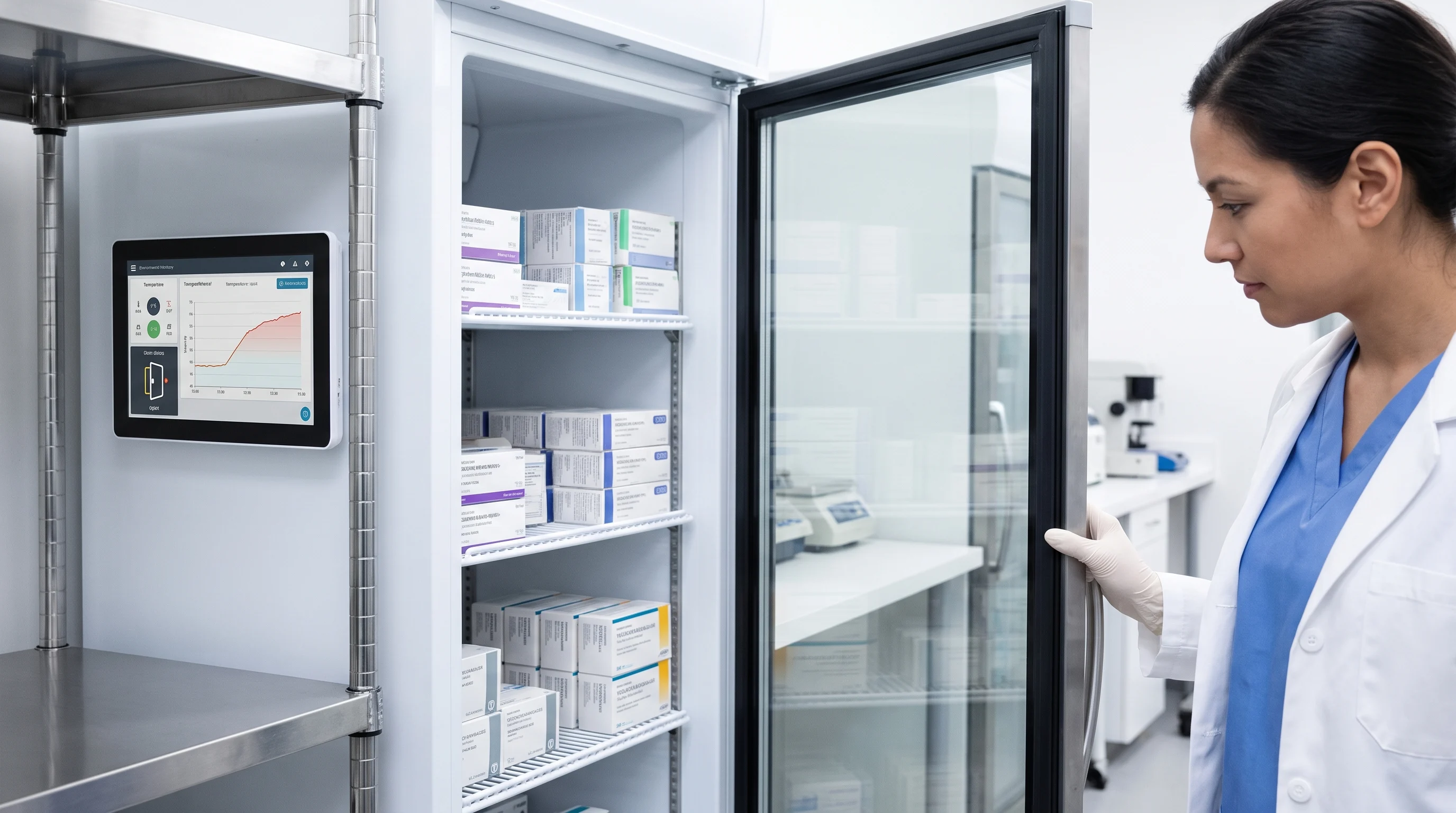
Closing the door does not close the investigation
A door-open alarm tells staff to check a refrigerator or freezer. Closing the door corrects the immediate condition; the temperature record tells them whether there is more to investigate.
That distinction should shape the alarm setup. For pharmacy, clinic, and laboratory teams, the useful questions are concrete: Has the door stayed open longer than normal work requires? Who can reach the unit? What happens if the temperature keeps rising after the door is closed?
Door status adds context to temperature monitoring. It cannot replace it or, by itself, establish whether stored products remained within their required conditions.
Start with the door nobody will notice
Door monitoring has a clear purpose where an open door might go uncorrected: a refrigerator in a back room, a freezer shared across shifts, or a unit left unattended after closing time.
Frequent access creates a different problem. During dispensing, inventory work, or replenishment, an open door is expected. An alert for every opening asks staff to respond to normal work. Repeated notifications that require no action can make the next meaningful alarm easier to overlook.
Before choosing a delay, describe both situations for each unit: what routine access looks like, and when a door left ajar would otherwise go unnoticed. A shared freezer and a refrigerator beside a staffed workstation may need different arrangements.
Choose a delay you can explain
The alarm delay separates ordinary access from a door-open condition that needs attention. A short delay may catch an unlatched door sooner, but also interrupt routine handling. A longer delay reduces those interruptions while postponing notification when something is wrong.
There is no universal delay for medical refrigerators and freezers. Choose and document the setting through the site’s review of the unit, normal handling, temperature response, and storage requirements.
When reviewing the setting, ask:
- Do alerts cluster around a routine task, such as replenishment?
- Do those events coincide with a concerning temperature trend?
- Would a longer delay leave a door ajar for too long before someone is notified?
- Does the arrangement still work when the room is unstaffed?
A recurring alert deserves investigation before a setting change. Its timing may reveal routine access, a closure problem, or a workflow that needs attention. Fewer notifications alone do not demonstrate that the configuration is better.
Assign the response, including access to the room
An after-hours contact needs to be able to reach the storage unit. Receiving an alert and acknowledging it are separate from checking the door.
Define the first responder, the backup, and the escalation path for staffed and unstaffed periods. Include access to the building and room, who takes over if the first person cannot respond, and who handles a temperature concern that remains after the door is closed.
Make the handoff explicit: who received the notification, who checked the unit, and who owns any follow-up. An acknowledgement should not be treated as evidence that the physical condition has been corrected.
Read the door event alongside the temperature trend
An open door followed by warming offers a plausible explanation for a temperature change. It does not establish that the door was the only cause. If warming continues after closure, the response needs to move beyond checking the latch.
A warming trend without a corresponding door event also needs investigation. Equipment operation, airflow, power, or the temperature sensor may warrant attention under the site’s procedure. The door record helps direct that investigation; it does not settle it.
Illustrative example, not a reported customer incident: A responder finds a medical refrigerator door partly open and closes it. They record the finding and action, then review the temperature trend. If the record raises a storage concern, or the temperature continues to rise, they follow the site’s temperature response procedure and involve the person responsible for decisions about the stored products. “Door closed” describes one corrective action, not the outcome of the entire event.
Keep a record that explains the response
The event record should connect the notification to what happened at the unit:
- When the alert arrived and who responded.
- Whether the door was open, ajar, or already closed when checked.
- What the responder found and corrected, including any obstruction or closure problem.
- What the temperature record showed around the event and after the correction.
- What follow-up or escalation occurred, and who took responsibility.
Use the site’s applicable procedure for temperature excursions and decisions about product assessment, quarantine, or relocation. A door alarm alone is not enough information to make those decisions.
Review these records with the people who use the units. Repeated alerts during the same task, missed responses, and warming that persists after closure each point to a different problem. The setting and response process should reflect what those records reveal.