
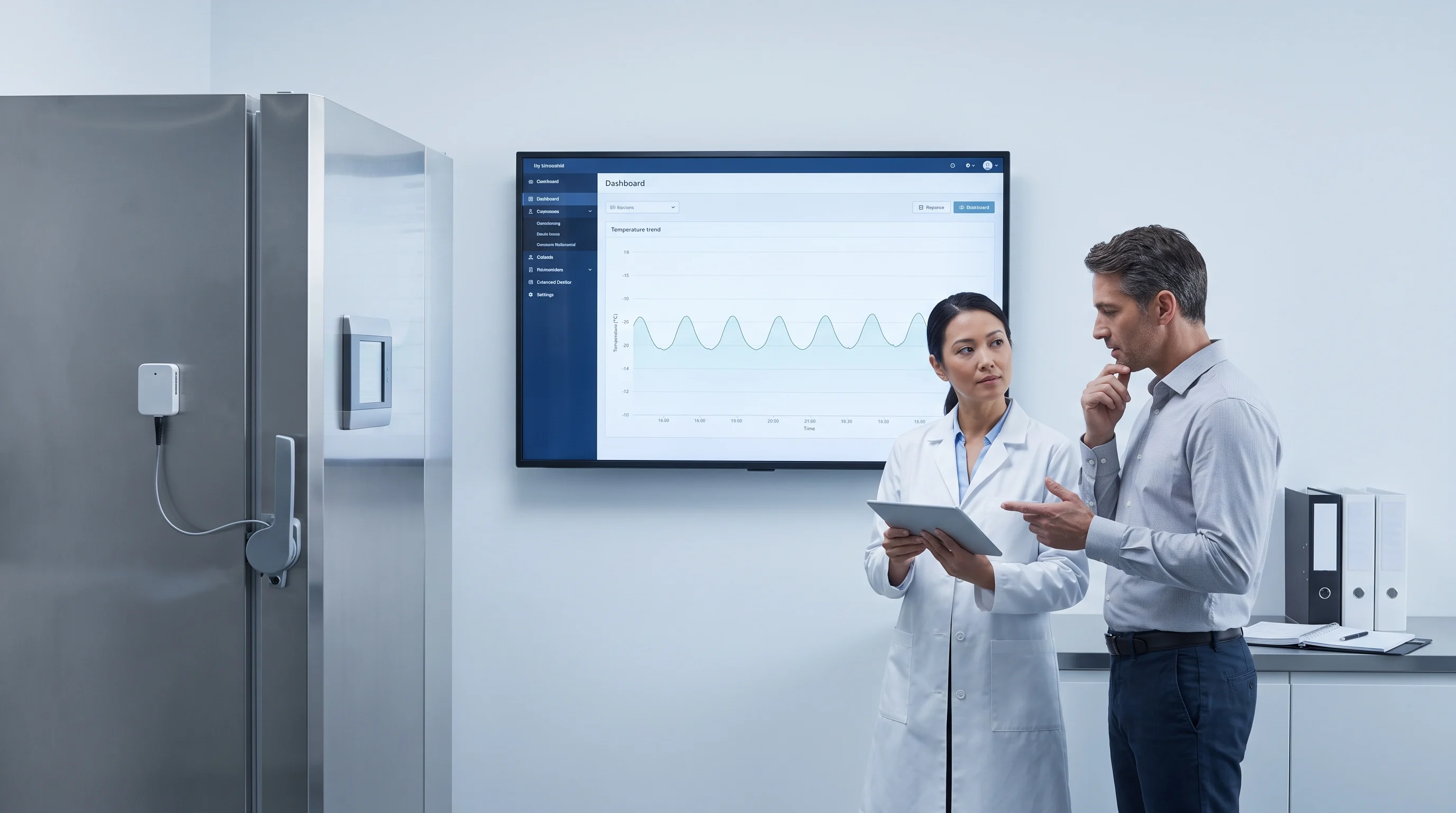
A recurring temperature rise can become so familiar that the next alert is closed as “just defrost.” That explanation needs checking each time: does this event still match the freezer’s documented behaviour, and is it acceptable under the storage requirements for its contents?
Those are separate questions. A freezer can repeat the same pattern without that pattern being acceptable for what it stores. It can also develop a longer recovery period while the peak temperature still looks familiar.
For laboratory, pharmacy, and facilities teams, the useful task is to compare the whole event with an established reference, then act on what has changed.
Define what “expected defrost” means for this freezer
Use baseline to mean a documented reference for this particular freezer under representative operating conditions. An average temperature is not enough. The reference needs to describe the recurring rise and the return to the usual operating range.
Keep the following together:
- The freezer, its storage use, and the applicable approved temperature requirements.
- The probe location and measurement setup, including any buffering arrangement.
- Representative trend periods showing the timing, height, duration, and recovery of recurring changes.
- Known door access, loading, or maintenance activity that helps explain differences between cycles.
- The assessment supporting why the pattern is considered expected and acceptable.
A recurring shape on a graph does not establish its cause. Check the explanation against what is known about the equipment and its operation before calling it defrost. If the cause remains uncertain, record that uncertainty.
Keep the reference specific to the unit. Another freezer’s trace cannot establish how this freezer should behave, especially when the probe location, load, or use differs.
Compare recovery as carefully as the peak
When an alert arrives, review the period before the rise, the rise itself, and the return to the usual trend. Looking only at the highest reading can hide a change in duration or recovery.
The comparisons below guide review; they are not diagnoses.
| What to compare | What a difference means for the review |
|---|---|
| Timing and frequency | A familiar-looking rise occurring more often needs an explanation. |
| Height of the rise | A higher peak is a departure to assess against both the baseline and storage requirements. |
| Duration | A similar peak with a longer event should not be closed on the strength of peak similarity. |
| Recovery | A slower return, or a failure to return to the previous range, changes the assessment. |
| Door access, loading, and maintenance | Changed operating conditions may make an older cycle a poor comparison. |
| Probe location and setup | A measurement change may make the old and new traces less comparable. |
Illustrative example, not customer data: A freezer has a previously assessed recurring rise. The next event reaches roughly the same peak, but the temperature takes longer to return to its usual range. Calling it “the same defrost cycle” would overlook the changed recovery. The reviewer preserves both traces, checks relevant loading, access, probe, and maintenance records, and follows the site’s investigation procedure. The graph establishes a difference; it does not identify the fault or determine the impact on stored material.
Explain what the probe can establish
The trend records temperature at the probe. It does not, by itself, describe every storage location or establish the condition of every item in the freezer.
A probe near a door, wall, or air path may show a different pattern from one elsewhere. That makes placement part of the interpretation, rather than a detail to retrieve only after an unexplained alert.
Before relying on a historical comparison, confirm that the probe location and setup still match the reference. Moving the probe, changing its buffering arrangement, rearranging storage, or changing the typical load should prompt a review of the baseline and alarm rationale. Retain applicable calibration and verification records with that context.
A smoother trace after moving a probe is evidence that the recorded trend changed. It is not sufficient evidence that storage conditions improved.
Treat an alarm delay as time spent before notification
A delay can reduce notifications from brief, assessed variations. It also postpones notification when a condition persists. The operational tradeoff is the time left for someone to respond.
Review the sequence explicitly: the condition begins, the configured delay elapses, someone receives the notification, and the responder takes action. A delay that covers a familiar cycle still needs to be assessed alongside the time required to reach the freezer and carry out the response.
Use the site’s controlled process to set thresholds and delays against the applicable storage requirements, expected variation, and response needs. Record the rationale and approval. There is no universal delay to take from this article.
Failure mode to avoid: An alert keeps recurring, so the delay is extended until notifications stop. If recovery has been getting slower, that change can conceal the pattern that needed review. Investigate why the alert repeats before deciding whether an alarm change is justified.
Close the event with evidence the next shift can use
A note that says only “defrost” leaves the next reviewer to reconstruct the decision. Record enough to explain why the event was accepted or escalated:
- The comparison: the event period, the baseline used, and differences in peak, duration, frequency, or recovery.
- The storage assessment: the applicable requirement and any assessment of stored material required by site procedure.
- The context: alarm history, known door access or loading, probe status and location, and relevant maintenance information.
- The action: who reviewed the event, what they did, and who owns any outstanding investigation or maintenance work.
A return to the usual temperature answers a recovery question. It does not automatically resolve the assessment of what happened while the temperature was elevated. Keep those conclusions explicit in the record.
When maintenance is involved, provide the event and its reference trace together. After the intervention, check whether the baseline and alarm settings still describe the unit’s operation. Otherwise, the next shift may keep comparing new behaviour with an outdated reference.
The decision rule is straightforward: treat a recurring variation as expected only when it matches a current, documented baseline and remains acceptable under the site’s approved storage requirements. A departure from either condition needs review. Familiarity alone is not a reason to close the event.