Start with the operating decisions
A pharmaceutical warehouse monitoring program is not defined by the number of sensors on a floor plan. It is defined by the decisions the program must support: which areas are treated as distinct zones, what a mapping exercise is meant to establish, who receives an alert, who owns the first response, and what record explains the event afterward.
ATEK supports environmental monitoring, mapping, alerts, and reporting for regulated storage environments. The supplied source material does not include site-specific mapping results, incident records, temperature limits, standard text, or regulatory interpretations. This article is therefore a planning framework, not a statement of GDP requirements or a validated warehouse design.
Define zones around operations, not only walls
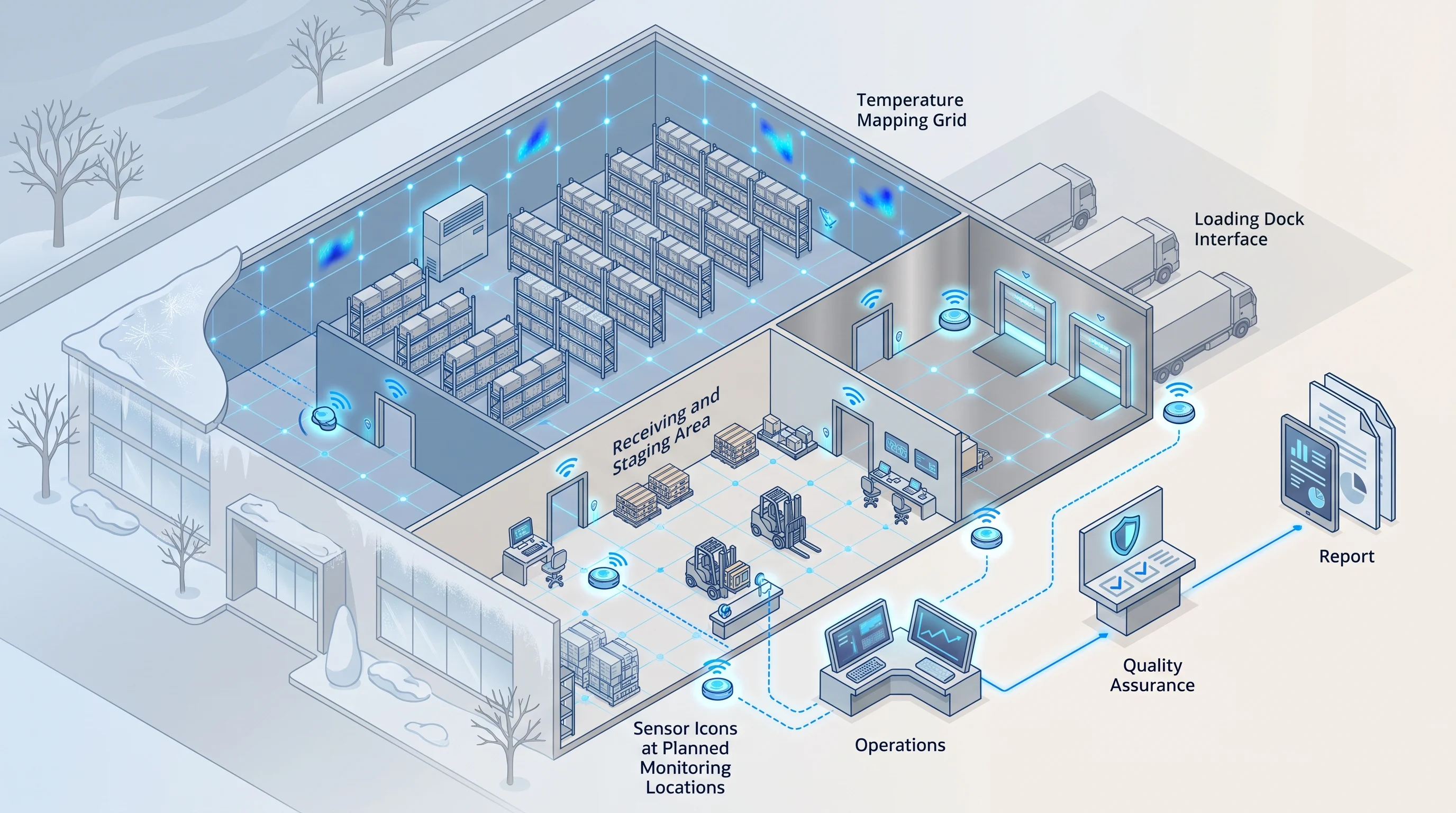
Begin by listing the operational areas that may need separate monitoring consideration. The supplied scope specifically identifies warehouse zones, loading docks, seasonal variation, and sensor placement.
A useful zone discussion asks:
- Which storage areas have different handling patterns or physical layouts?
- Which areas are adjacent to loading or receiving activity?
- Where do products wait during receiving, staging, picking, or dispatch?
- Which seasonal conditions should the mapping and monitoring plan consider?
- Who can explain why a sensor location represents the area it is intended to monitor?
This does not mean every named area automatically needs its own sensor or its own alarm rule. It means the team should make that decision explicitly and retain the rationale.
Decision rule: Define a separate zone when the team can identify a materially different operating condition, workflow, or physical context that requires its own monitoring rationale. If the rationale cannot be stated, record that uncertainty and resolve it through the site’s approved assessment or mapping process.
Use mapping to answer a placement question
Temperature mapping and ongoing monitoring serve related but different purposes. Mapping is the activity used to understand conditions across a defined space and under defined circumstances. Ongoing monitoring is the continuing observation used to detect and document conditions after the monitoring design is established.
The key handoff is not simply a map with points on it. It is a documented decision about sensor placement and its basis.
Illustrative example: This is a fictional planning scenario, not customer data. A warehouse team treats an enclosed storage area, a receiving/staging area, and a loading dock interface as separate areas for assessment. The team uses its mapping work and operational knowledge to decide whether each area needs ongoing monitoring, then documents the placement rationale and the responsible owner. The source notes do not provide the result that this assessment should produce.
Caveat: No mapping protocol, seasonal study design, acceptance criteria, or standard requirement was provided in the source material. [EDITORIAL PLACEHOLDER: source needed for the site-approved mapping protocol, the seasonal conditions to be assessed, and the documented basis for sensor-location decisions.]
Design alarms around ownership and response
An alarm without a named response path can create a record of a problem without creating a controlled response. Before configuring notifications, agree on the operational questions:
- What condition triggers an alert?
- Which role receives the first notification?
- Who assesses the condition when the first recipient is unavailable?
- Who has authority to take immediate operational action?
- When is quality assurance involved?
- What information must be captured in the event record?
The source material identifies escalation workflows as a core consideration. It does not establish alert thresholds, response times, or escalation tiers. Those details should come from the organization’s approved procedures and its documented storage conditions.
Failure mode: A notification list names several recipients but no person or role owns the first assessment. Each recipient may assume someone else is responding, while the alert remains open without a documented decision. Assigning an owner, a backup, and an escalation path makes the workflow testable.
Make reports usable after the event
Reporting should support routine oversight as well as event review. A report is more useful when it allows the team to connect a condition, an alert, a response, and the resulting record without reconstructing the sequence from separate systems.
For each report type, define its purpose before choosing its format:
- Routine review: confirms that monitoring records are available for the defined period.
- Alert review: shows the condition, notifications, acknowledgements, and documented response.
- Mapping record: preserves the scope, conditions, results, and decisions used to support the monitoring design.
- Change review: records why zones, sensor locations, alarms, or escalation ownership were changed.
[EDITORIAL PLACEHOLDER: source needed for approved report templates, retention expectations, review roles, and the records required by the organization’s quality system.]
A practical pre-implementation checklist
Before commissioning or revising a warehouse monitoring plan, confirm that the team can answer the following in writing:
- What are the defined warehouse zones and why do they differ?
- How will loading docks and staging activities be assessed?
- Which seasonal conditions are in scope?
- What mapping work informs sensor placement?
- Who owns each alert from first notification through escalation?
- What report documents routine review and event response?
- What approved process governs changes to the monitoring design?
The point is not to impose one universal layout. It is to make the chain from zone definition to sensor placement, alert response, and reporting visible enough to review, operate, and improve.
What is still needed for a site-ready plan
Firsthand warehouse material is missing from the supplied notes. A site-ready article or procedure would need [EDITORIAL PLACEHOLDER: source needed for an anonymized operational example, such as a seasonal review, loading-dock assessment, alarm-response handoff, or documented change to sensor placement], along with approved internal procedures and any applicable source text for regulatory or quality-system requirements.