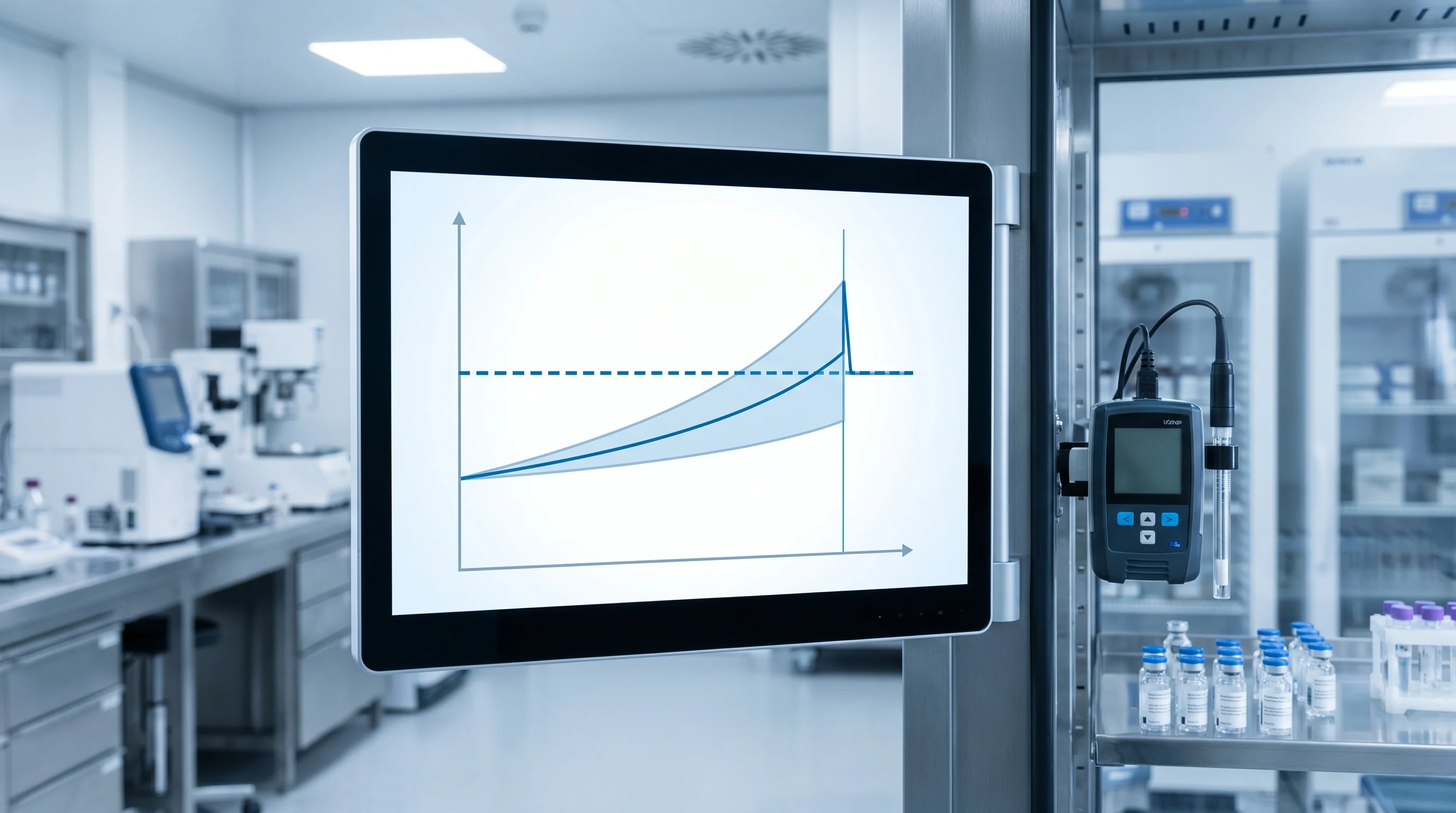

Calibration intervals are often treated like a calendar setting.
That is the wrong mental model.
For environmental monitoring, a calibration interval is a documented claim about how long a sensor can be trusted between checks for a specific job, in a specific environment, under a specific tolerance. A refrigerator probe protecting vaccines, a cleanroom differential pressure sensor, and a humidity probe inside a stability chamber may all have annual dates on paper. They do not carry the same risk.
The useful question is not “How often do we calibrate this model?”
The useful question is: “What evidence lets us defend this interval if the sensor is later found drifting?”
Regulatory note: use your approved SOP, risk assessment, product requirements, and quality system. This article is a practical structure for interval justification, not a substitute for regulatory or quality approval.
Start With the Measurement Job
Before setting an interval, define what the sensor is doing.
Capture these fields first:
- monitored asset or room
- parameter, such as temperature, relative humidity, differential pressure, CO2, oxygen, or door status
- sensor ID and probe ID, if separate
- operating range and alarm limits
- required measurement tolerance
- stored material, process, or room condition affected by the reading
- response time needed if the value moves out of range
- calibration history and any previous as-found failures
- environmental stress, including cycling, humidity, cleaning exposure, vibration, handling, or frequent relocation
This step prevents a common mistake: assigning intervals by sensor type alone.
Two identical temperature probes can deserve different controls. One might sit undisturbed in an ambient laboratory. Another might be routed through a freezer door gasket, handled during defrosts, exposed to ice buildup, and used to protect high-value samples. Same model. Different job. Different risk.
Four Inputs That Actually Matter
A defensible interval usually comes from four inputs working together.
| Input | What it tells you | How it affects the interval |
|---|---|---|
| Criticality | What decision depends on the reading | Higher product, patient, study, or room-classification risk pushes toward tighter control |
| Required tolerance | How much error the process can absorb | Narrow tolerance leaves less room for unnoticed drift |
| Environmental stress | How hard the sensor’s daily life is | Cycling, humidity, cleaning, movement, and harsh placement increase review pressure |
| As-found history | How the device behaved before adjustment | Stable history can support the existing interval; drift or out-of-tolerance findings require action |
Manufacturer recommendations are useful as a starting point. They are not the whole justification. They usually do not know your storage range, alarm delay, probe placement, maintenance practice, response coverage, or product risk.
As-Found Data Is the Interval Signal
The most useful calibration result is often the as-found reading: how the sensor performed when it arrived for calibration, before adjustment.
As-left readings prove the sensor was adjusted or confirmed before returning to service. As-found readings tell you whether the previous interval was reasonable.
Failure mode: treating calibration as a reset button.
If a sensor is found out of tolerance, the calibration event is not finished when the certificate is filed. The quality question becomes retrospective:
- How long may the sensor have been drifting?
- Which monitored records depended on that reading?
- Did the drift move readings toward false-safe or false-alarm conditions?
- Were any excursions missed, understated, or overstated?
- Does the affected material, room, or process need an impact assessment?
- Should the interval change for this asset, this model, or this risk category?
A calibration program that ignores failed as-found data is only maintaining stickers. It is not controlling measurement risk.
A Practical Decision Rule
Use this as an interval-review pattern, not as a universal SOP.
| Calibration result | Practical interpretation | Interval action |
|---|---|---|
| In tolerance with stable trend | Current interval is supported by evidence | Keep interval unless risk, use, or environment changed |
| In tolerance but drifting toward limit | The interval may still be acceptable, but margin is shrinking | Keep or shorten; add trend review before next cycle |
| Out of tolerance, low-risk point | Measurement control failed, but impact may be limited | Document impact assessment; shorten or hold interval until stability is shown |
| Out of tolerance, critical point | Historical records may not be reliable enough without review | Open quality assessment; shorten interval; consider replacement or added verification |
| Repeated failures on same model or location | The issue may be placement, environment, handling, or model fit | Review root cause before simply recalibrating again |
The important move is to separate “this sensor passed today” from “the last interval was justified.” Those are different claims.
Common Shortcut: Annual by Default
Annual calibration is common in environmental monitoring, and it can be a reasonable baseline for many programs. The problem starts when “annual” becomes the justification instead of the output of the justification.
Weak rationale: “All sensors are calibrated annually.”
Stronger rationale: “Temperature probes used for critical cold storage are calibrated annually because the risk assessment classifies them as high criticality, the required tolerance is within the process margin, the manufacturer baseline supports annual service, and the last three as-found results stayed within acceptance limits. Any out-of-tolerance as-found result triggers impact assessment and interval review.”
The stronger version gives an auditor, quality manager, or metrology coordinator something to inspect. It names the risk category, the tolerance logic, the evidence, and the trigger for changing the decision later.
When to Shorten the Interval
Shorten the interval when the evidence says the current interval is consuming too much measurement margin.
Typical triggers:
- out-of-tolerance as-found result
- repeated near-limit as-found results
- drift moving consistently in one direction
- sensor moved to a harsher location
- tighter product, room, or process requirement
- repeated excursions where sensor accuracy affects the investigation
- physical damage, condensation, cable stress, or probe-placement concerns
- a change in SOP that makes the reading more decision-critical
Do not shorten the interval as a substitute for root cause.
If the same freezer probe fails repeatedly because the cable is crushed in the door gasket, a shorter interval may reduce exposure time, but it does not solve the installation problem. If humidity sensors drift because cleaning practice exposes them to conditions outside their intended use, the interval is only one control. Placement, protection, training, and device selection may matter more.
When Extension Is Defensible
Extending calibration intervals is possible, but it should be harder than keeping the current interval.
Good evidence for extension includes:
- multiple consecutive in-tolerance as-found results
- no meaningful drift trend
- stable operating environment
- unchanged sensor placement and use
- low or moderate criticality
- enough process margin that the remaining measurement uncertainty is acceptable
- documented quality approval for the change
Risky extension: lengthening an interval because no one complained.
Silence is not stability. Stability comes from records: as-found results, trend review, unchanged conditions, and a documented decision owner.
What the Interval Justification Should Contain
Keep the record simple enough that it can be maintained, but specific enough that it can be defended.
Minimum fields:
- asset, sensor, and probe identifiers
- location and monitored parameter
- criticality category and reason
- operating range, alarm limit, and required tolerance
- manufacturer recommendation or baseline, if used
- selected calibration interval
- last calibration date and next due date
- latest as-found and as-left status
- trend summary from prior calibrations
- rationale for keeping, shortening, or extending the interval
- reviewer, date, and approval reference
- trigger conditions for reopening the interval decision
Illustrative record, not an ATEK customer record:
| Field | Example |
|---|---|
| Asset | Vaccine refrigerator VR-02 |
| Parameter | Temperature |
| Criticality | High: refrigerated medication storage |
| Tolerance logic | Sensor accuracy must leave enough margin against storage limits and alarm thresholds |
| Current interval | 12 months |
| Evidence | Three consecutive in-tolerance as-found results; no relocation; no repeated excursions linked to sensor accuracy |
| Trigger to review | Any out-of-tolerance as-found result, relocation, probe damage, or change in storage requirement |
| Decision | Keep 12-month interval; review after next calibration cycle |
The exact values belong to your SOP and quality system. The structure is the point: someone can see why the interval exists and what would make it change.
Do Not Let Calibration Become Isolated From Monitoring
Calibration records, alarm history, excursion investigations, and asset configuration should not live in separate worlds.
When a sensor fails as-found calibration, the monitoring record gives context. Did the asset have excursions? Were alarms near the limit? Was the sensor offline? Did the probe move? Did staff report nuisance alarms? Did maintenance change the equipment?
When an excursion occurs, calibration status gives confidence. Was the sensor current? Was it close to due? Did prior as-found history show drift? Does a second sensor agree?
This is why environmental monitoring should be managed as a control system, not as a pile of certificates. The value is not only that a calibration certificate exists. The value is that the certificate can be connected to the decisions the sensor supported.
ATEK’s calibration services, cloud reporting tools, and validation support are designed around that operational link: traceable calibration, usable records, and evidence that quality teams can review when something changes.
The Standard Is Not the Date. It Is the Decision.
A calibration interval is defensible when the record answers three questions:
- Why is this interval appropriate for this sensor’s job?
- What evidence shows the previous interval worked?
- What would cause the interval to change?
If those answers are missing, the date on the sticker is doing too much work.
If those answers are documented, the calibration program becomes more than maintenance. It becomes part of the facility’s ability to trust its environmental monitoring data, investigate excursions, and make quality decisions without relying on memory.