Understanding FD X 15-140
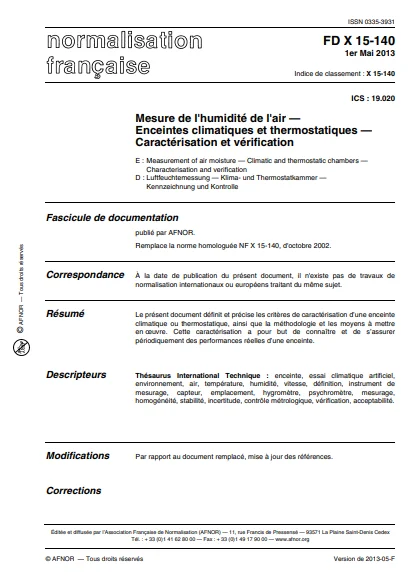
FD X 15-140 is a French guidance document (fascicule de documentation) published by AFNOR that defines recommended methods for the characterisation and verification of climatic and thermostatic chambers used in laboratory, research, and industrial testing environments. The document provides informative guidance on evaluating enclosure performance, covering chambers that regulate temperature alone or temperature and humidity together.
Scope and Application
The document applies to enclosures designed to perform tests at atmospheric pressure, including:
- Thermostatic enclosures (temperature control only)
- Climatic enclosures (temperature and humidity control)
- Enclosures with or without forced air circulation
The applicable ranges are -100 degC to +600 degC for temperature and 0% to 100% RH for relative humidity (at temperatures between 0 degC and 100 degC).
FD X 15-140 replaces NF X 15-140 (October 2002) and is particularly relevant in France, where it supports alignment with other regulatory frameworks including pharmaceutical quality standards and environmental testing requirements.
Key Technical Guidance
Characterisation Programme: Enclosures should be characterised according to a programme that determines performance at the specified conditions, with a minimum of 3 setpoints for thermostatic enclosures and 9 setpoints for climatic enclosures.
Measurement Methodology: Humidity measurement should employ calibrated instruments with traceability to national standards. The document describes three methods: condensation hygrometer, psychrometer, and impedance-variation hygrometer, each with specific uncertainty characteristics.
Spatial Uniformity Verification: Homogeneity should be assessed using sensors placed at defined positions within the working space (9 sensors for volumes up to 2 m3, 15 for up to 20 m3), with temperature and humidity homogeneity reported together.
Temperature-Humidity Interaction: Temperature tolerances directly affect achievable humidity tolerances. For example, at 50% RH and 20 degC, a temperature EMT of +/-1 degC induces +/-3.1% RH variation, making tight RH specifications impossible without correspondingly tight temperature control.
Environmental Stability Assessment: Stability is determined in steady state at each measurement point, with steady state verified either graphically or via a statistical method using 30-measurement intervals at 95% confidence level.
Formal Verification: Characterisation results are compared with enclosure specifications to conclude on conformity. The conformity rule requires that each sensor mean +/- its expanded uncertainty falls within the EMT interval.
Documentation and Reporting: Characterisation reports must include enclosure identification, all measurement results, traceability references, measurement uncertainties, and the state of adjustments. Verification certificates must include conformity judgements.
How ATEK Supports FD X 15140 Compliance
ATEK’s environmental monitoring platform is designed to streamline compliance with FD X 15140 by automating data collection, analysis, and documentation throughout the equipment lifecycle.
Comprehensive Monitoring Infrastructure
Our platform supports integration with multiple humidity sensors deployed throughout your enclosure, enabling:
- Real-time measurement at multiple points simultaneously
- Automated data logging with full audit trails
- Visual mapping of humidity distribution patterns
- Identification of spatial variations and problem areas
Verification and Qualification Support
ATEK provides tools to support formal qualification activities:
- Customizable verification protocol templates based on FD X 15140 requirements
- Automated data collection and analysis during qualification runs
- Statistical analysis of uniformity across measurement points
- Comprehensive qualification reports with all required documentation
Continuous Compliance Monitoring
Beyond initial qualification, ATEK ensures ongoing compliance through:
- Continuous environmental monitoring with configurable alert thresholds
- Automated trending analysis to detect performance drift or degradation
- Regular performance validation reports with compliance status
- Historical data retention for audit and investigation purposes
Environmental Analysis Tools
Advanced analytical capabilities help optimize and validate your humidity chambers:
- Temperature-humidity correlation analysis to assess control system interaction
- Stability assessment over defined time periods
- Trend analysis identifying long-term performance patterns
- Alert generation when measurements exceed acceptable ranges
Implementation Best Practices
Initial Equipment Characterization
Begin with comprehensive characterization of each humidity enclosure:
- Install calibrated humidity sensors at representative locations throughout the chamber
- Define measurement points based on equipment design and operational areas
- Document baseline performance and establish control limits
- Create detailed characterization reports for regulatory records
Verification Protocol Development
Establish formal verification procedures:
- Define specific performance acceptance criteria based on FD X 15140 requirements
- Develop detailed protocols including measurement locations, duration, and frequency
- Specify data analysis methods and acceptance criteria
- Document all procedures in operational SOPs
Performance Validation Schedule
Implement a risk-based validation schedule:
- Establish baseline validation frequency based on equipment age and historical performance
- Create automated reminders for periodic re-validation activities
- Review validation results to identify any performance trends
- Adjust validation frequency based on observed performance patterns
Documentation and Record Keeping
Maintain comprehensive documentation:
- Store all characterization and verification reports with timestamps
- Maintain complete calibration history for all sensors and instruments
- Document all corrective actions and equipment maintenance
- Retain historical data for trend analysis and regulatory review
Technical Specifications
Measurement Points: 9 sensors for enclosures up to 2 m3 (8 at corners of the working space plus 1 at the centre), and 15 sensors for enclosures between 2 m3 and 20 m3 (9 as above plus 6 at the centre of each face). Sensors are placed at 1/10th of each internal dimension from the walls.
Measurement Uncertainty: Achievable uncertainty depends on the method used. At 25 degC and 40% RH with good calibration: condensation hygrometer achieves 0.7% RH, psychrometer 1.5% RH, and impedance hygrometer 2.1% RH (expanded uncertainty, k=2).
Response Time: Sensors must respond to environmental changes within specified timeframes to capture accurate environmental dynamics.
Monitoring Duration: Each characterisation setpoint requires a minimum 30-minute measurement period in steady state, with at least 30 readings per sensor recorded at most every 1 minute.
Data Logging: All measurement data must be electronically recorded with timestamps, sensor identification, and full audit trails.
Regulatory Context
FD X 15140 supports compliance with several other regulatory frameworks:
- ISO 15189 for medical laboratory quality management
- ISO 20387 for biobanking and research facilities
- Pharmaceutical stability testing requirements
- Environmental test chamber qualification standards
Common Challenges and Solutions
Challenge: Identifying optimal sensor placement for spatial uniformity assessment. Solution: ATEK provides guidance on sensor distribution patterns and supports dynamic mapping of humidity patterns to identify critical measurement locations.
Challenge: Managing large volumes of monitoring data and extracting meaningful insights. Solution: ATEK’s automated analysis tools provide statistical summaries, trend visualization, and exception reporting to highlight important patterns and anomalies.
Challenge: Maintaining documentation and demonstrating ongoing compliance during regulatory inspections. Solution: ATEK generates comprehensive audit reports and compliance documentation automatically, with full traceability of all monitoring activities and findings.
Conclusion
FD X 15-140 provides essential guidance for ensuring that climatic and thermostatic chambers operate reliably and consistently for laboratory and research applications. ATEK’s environmental monitoring platform simplifies alignment with this guidance by automating data collection, analysis, and documentation while providing the detailed insights needed to optimise equipment performance and support regulatory requirements.