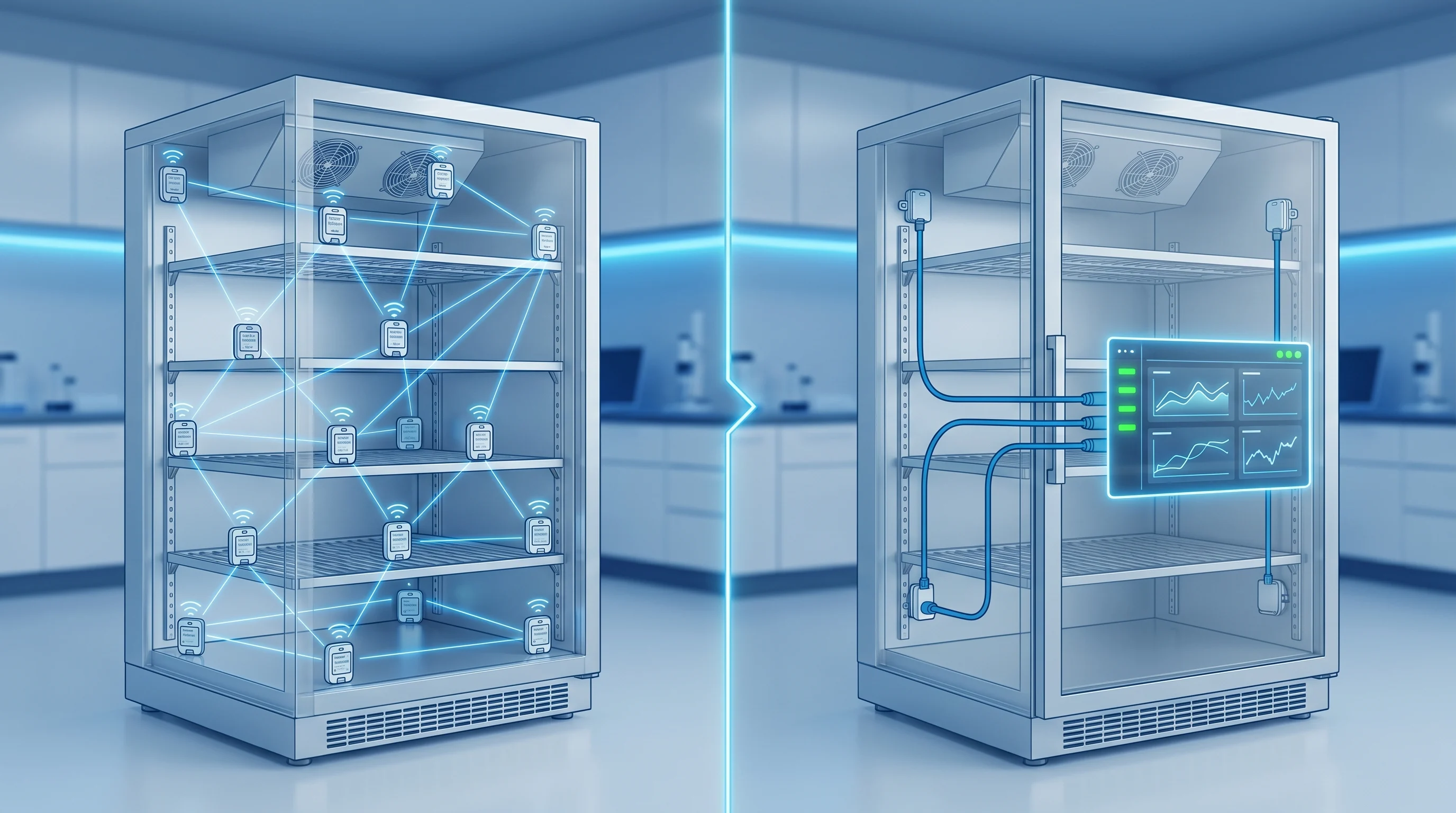
La surveillance environnementale en sciences de la vie est souvent décrite avec le vocabulaire des capteurs, des tableaux de bord et des rapports de conformité. Je pense que cette façon de voir les choses passe à côté de l’essentiel.
Une lecture de température n’a jamais sauvé un échantillon. Un graphique de pression en salle blanche n’a jamais protégé un lot. Un rapport de conformité n’a jamais arrêté une défaillance en cours. Une décision humaine prise à temps, oui.
C’est comme ça que je vois la place d’ATEK dans cette industrie.
D’un côté de notre monde, il y a des électrons, des variations de tension, des paquets de données, des franchissements de seuils, des niveaux de batterie et des lectures horodatées qui proviennent des dispositifs de surveillance. De l’autre, il y a une personne qui doit prendre une décision sous pression : déplacer du matériel, envoyer l’équipe des installations, escalader à l’assurance qualité, mettre un produit en quarantaine, vérifier une pièce ou documenter une excursion avant qu’elle ne devienne une observation. ATEK se situe au milieu de cette chaîne, dans la partie qui compte le plus.
La surveillance environnementale mesure des indicateurs, pas les résultats
Personne n’achète un système de surveillance environnementale parce qu’il est émotionnellement attaché à la température, à l’humidité ou à la pression différentielle.
On l’achète parce que ces mesures représentent quelque chose de plus important.
Dans un laboratoire de biotechnologie, la température représente l’intégrité des échantillons. Dans un hôpital ou une pharmacie, elle représente la sécurité des médicaments. Dans une salle blanche, la pression différentielle représente le contrôle de la contamination. Dans une cuve cryogénique, la mesure de niveau représente la viabilité de matériel irremplaçable.
Cette distinction est importante, parce qu’elle change ce qu’est réellement un bon système de surveillance environnementale.
Si ce que vous protégez vraiment est la viabilité des échantillons, la qualité du produit ou le contrôle opérationnel, alors le travail ne consiste pas seulement à mesurer avec précision. Le travail consiste à aider quelqu’un à agir avant que l’indicateur ne dérive assez pour endommager la réalité qu’il représente.
C’est ici que le récit habituel de l’industrie devient insuffisant. On parle souvent de la surveillance comme si c’était surtout un problème de collecte de données. Installer le capteur. Enregistrer les lectures. Mettre un graphique dans le cloud. Envoyer une alerte quand un seuil bouge. D’un point de vue technique, tout cela compte. Mais sur le plan opérationnel, ce n’est pas complet.
Une excursion enregistrée avec précision, mais à laquelle personne ne répond, n’est pas une réussite. C’est un échec avec une meilleure paperasse.
Le vrai produit, c’est de raccourcir la distance jusqu’à la décision
Le modèle mental que j’utilise pour cela est la distance jusqu’à la décision.
La distance jusqu’à la décision, c’est le nombre d’étapes entre un changement physique dans l’environnement et une action humaine défendable.
Plus cette distance est courte, meilleur est le système.
Plus elle est longue, plus la plateforme risque d’avoir l’air solide en démonstration et de décevoir dans le monde réel.
Voici à quoi ressemble une longue distance jusqu’à la décision en pratique. Un congélateur ULT commence à dériver à 2 h 13 du matin. La sonde le capte. La plateforme l’enregistre. Une alerte est envoyée à une boîte courriel générique. Le message dit que la température est élevée, mais ne donne aucun contexte sur la gravité, l’historique ou ce qui est à risque. Quelqu’un le voit vingt minutes plus tard, suppose que c’est encore un événement sans importance, et attend. La bonne personne est impliquée trop tard.
Mesuré correctement. Raté opérationnellement.
Ce type d’échec est plus courant qu’on ne l’admet. La plupart des environnements surveillés ne souffrent pas d’un manque d’information. Ils souffrent d’un excès d’urgence sans contexte. Les équipes sont inondées de bruit, apprennent que plusieurs alertes sont sans conséquence et finissent par traiter le système comme un fond sonore. C’est ainsi que se construit la fatigue d’alarme. Pas à partir d’une seule grande erreur, mais par exposition répétée à des alertes qui exigent de l’attention sans la mériter.
Une courte distance jusqu’à la décision est différente. Le signal est préservé et horodaté. Si la connectivité tombe, les données sont mises en mémoire tampon et récupérables. L’alerte atteint immédiatement la bonne personne ou le bon chemin d’escalade. Le message contient assez de contexte pour dire à l’opérateur ce qui compte maintenant, pas seulement quel chiffre a bougé. La réponse est visible. Le suivi est documenté. Si quelqu’un doit reconstruire l’événement plus tard, la chaîne tient.
Pour moi, c’est le vrai produit de la surveillance environnementale en sciences de la vie. Pas plus de graphiques. Pas plus de télémétrie brute. Moins de distance entre le signal et l’action.
En environnement réglementé, la conformité prouve la chaîne de décision
Je pense aussi que notre industrie se trompe souvent sur la conformité.
Dans beaucoup de marchés logiciels, la conformité est traitée comme une couche qu’on ajoute une fois que le produit est assez mature. On construit d’abord le système principal. Ensuite, on ajoute les contrôles, la documentation et les fonctions d’audit. Cette façon de penser peut fonctionner dans certaines catégories. Elle ne fonctionne pas dans les environnements réglementés par la FDA.
Quand les gens parlent de FDA 21 CFR Part 11, ils se concentrent généralement sur les enregistrements électroniques, les signatures électroniques et les pistes d’audit. Tout cela est réel. Mais la raison pratique pour laquelle c’est important est plus simple que le langage réglementaire ne le laisse croire.
La conformité est la manière de prouver que la chaîne de décision était contrôlée.
Si un environnement surveillé est sorti de sa plage acceptable, que s’est-il passé ensuite?
Qui a vu l’alerte?
Quand l’a-t-il vue?
Qui l’a acquittée?
Quelle action a été prise?
L’enregistrement original a-t-il été préservé?
Peut-on reconstruire toute la séquence six mois plus tard, pendant une enquête ou une inspection?
Si la réponse à ces questions est floue, le problème n’est pas seulement documentaire. Il est opérationnel.
C’est pour cela que je ne sépare pas l’utilisabilité de la conformité dans ma façon de penser. Les mêmes choix de conception qui rendent une plateforme de surveillance plus utile pendant un vrai événement la rendent aussi plus défendable par la suite : horodatages fiables, responsabilité claire, escalade structurée, enregistrements immuables, données tamponnées pendant les interruptions et pistes d’audit qui ne dépendent pas de la mémoire de quelqu’un.
La conformité n’est pas là pour impressionner les auditeurs. Elle est là parce que, dans les environnements à forts enjeux, “faites-nous confiance, nous l’avons géré” n’est pas une conception de système sérieuse.
ATEK se situe dans la couche la plus difficile et la plus précieuse
C’est pourquoi je pense que la position d’ATEK dans l’industrie est plus forte qu’elle peut en avoir l’air de l’extérieur.
Beaucoup d’entreprises peuvent vendre du matériel. Beaucoup d’entreprises peuvent construire des tableaux de bord. Les deux comptent. Aucun des deux, seul, ne suffit.
La partie difficile est la couche intermédiaire où un événement physique devient un jugement opérationnel.
Cette couche intermédiaire doit bien faire plusieurs choses à la fois. Elle doit préserver la qualité du signal. Elle doit survivre à une connectivité imparfaite. Elle doit contextualiser l’événement. Elle doit acheminer l’alerte correctement. Elle doit réduire le bruit au lieu d’en ajouter. Elle doit créer un enregistrement capable de résister à un examen ultérieur. Et elle doit faire tout cela dans des environnements où les conséquences en aval peuvent être financières, scientifiques, réglementaires et parfois très proches des soins aux patients.
C’est la couche où la valeur se compose.
Une lecture brute ne devient utile que lorsqu’elle est horodatée, mise en mémoire tampon, contextualisée, escaladée, acquittée et enregistrée. C’est dans cette séquence que la confiance se construit. C’est aussi là que la différenciation devient plus difficile à copier.
C’est pourquoi je ne vois pas ATEK seulement comme une entreprise de dispositifs ou seulement comme une entreprise logicielle. Je la vois comme une infrastructure de décision pour les environnements réglementés.
C’est une affirmation différente. C’est aussi une affirmation plus juste.
La bonne question n’est pas “qu’est-ce que le capteur a vu?”
Quand j’évalue maintenant une plateforme de surveillance environnementale, je ne commence pas par le tableau de bord.
Je commence par une question plus simple : que se passe-t-il ensuite?
Que se passe-t-il après que le signal quitte le dispositif?
Que se passe-t-il si la première alerte est ignorée?
Que se passe-t-il si le réseau tombe?
Que se passe-t-il quand l’assurance qualité demande l’enregistrement plus tard?
Que se passe-t-il quand l’événement survient la fin de semaine, pendant un changement de quart ou dans une installation où la responsabilité est partagée entre les opérations, les installations et la qualité?
Ces questions révèlent davantage sur la solidité d’un système de surveillance que n’importe quelle capture d’écran de produit.
Si vous voulez un test rapide, voici celui que j’utilise :
- Le système envoie-t-il les alertes à la personne réellement responsable, ou seulement à la personne la plus facile à notifier?
- L’alerte explique-t-elle ce qui est à risque, ou seulement qu’un seuil a été franchi?
- La plateforme réduit-elle la fatigue d’alarme, ou entraîne-t-elle les gens à l’ignorer?
- Le système peut-il préserver et reconstruire proprement l’événement si la connectivité échoue?
- Pouvez-vous prouver toute la chaîne d’actions plus tard, sous un examen de type FDA 21 CFR Part 11?
Si la réponse à ces questions est faible, alors le système est plus faible qu’il n’en a l’air.
Si la réponse est forte, alors vous ne regardez pas seulement un système de surveillance environnementale. Vous regardez un vrai système de contrôle opérationnel.
Électrons en entrée, décisions en sortie
Je pense que la prochaine phase de la surveillance environnementale en sciences de la vie sera façonnée par les entreprises qui comprennent dans quel métier elles sont réellement.
L’entrée, ce sont les signaux électroniques provenant des dispositifs de surveillance.
La sortie, ce sont les décisions.
Tout ce qui se trouve entre les deux, c’est là que vit le vrai produit.
C’est la couche où le signal devient contexte, où le contexte devient escalade, où l’escalade devient action, et où l’action devient preuve. C’est la couche qui protège la recherche, le produit et la conformité en même temps. C’est aussi la couche qui décide si un système de surveillance est simplement informatif ou réellement utile.
C’est ainsi que je vois le rôle d’ATEK dans cette industrie.
Pas comme un fournisseur de lectures isolées.
Pas comme un vendeur de tableaux de bord plus beaux.
Comme une infrastructure pour prendre de meilleures décisions dans des environnements où attendre trop longtemps est souvent l’erreur la plus coûteuse qu’on puisse faire.
Vous voulez voir comment cette façon de penser se reflète dans le produit? Parlez à notre équipe.