
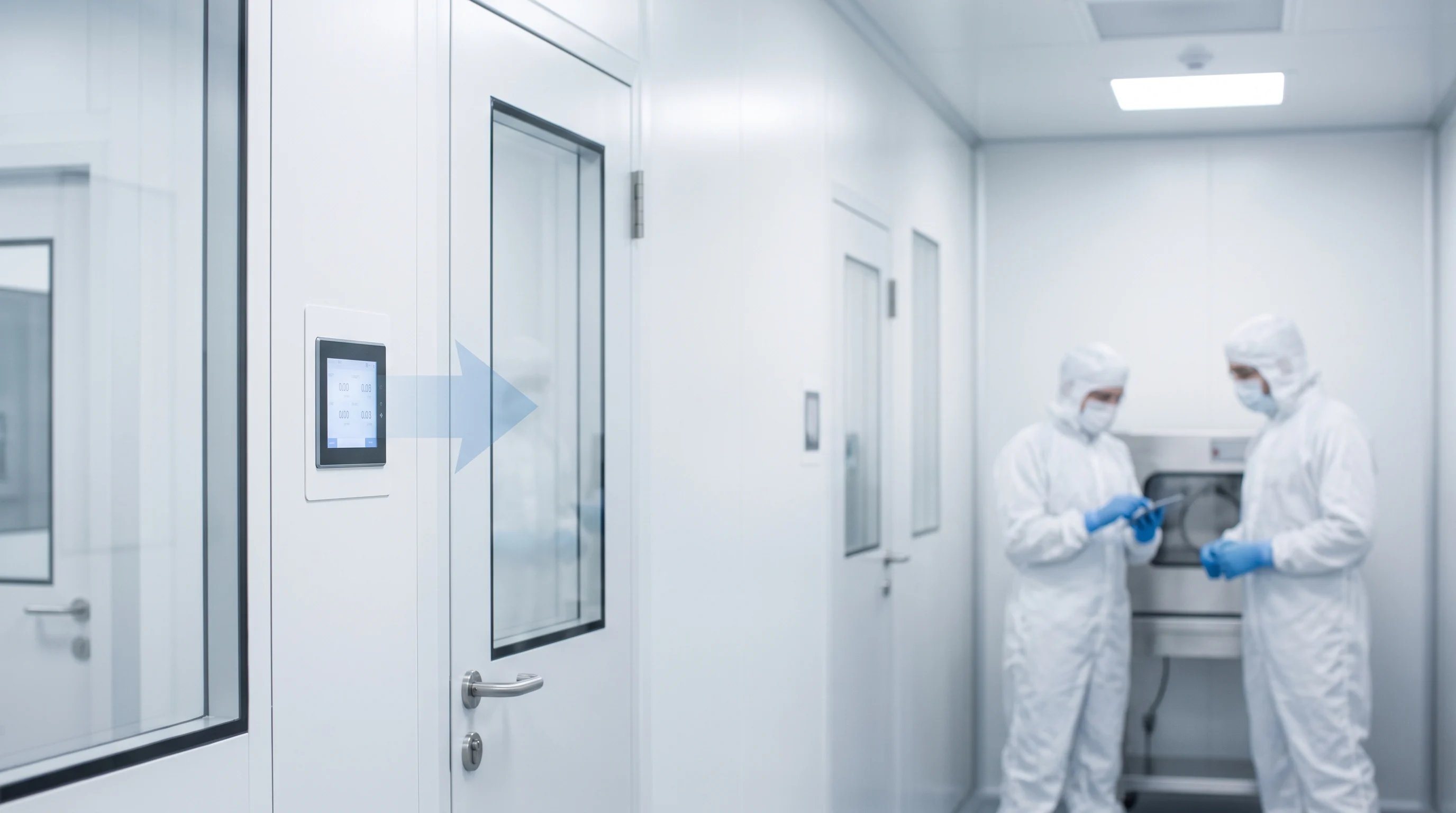
A differential pressure value is not the control. The control is the defined relationship between two spaces, the reason that relationship matters, and the response when it weakens or reverses.
That distinction changes how a cleanroom pressure point should be named, alarmed, trended, and investigated. A transmitter can show that the pressure difference across two taps changed. It cannot tell the team why it changed, whether the entire airflow pattern failed, or what happened to work in progress. Those conclusions require room context, operating records, facilities information, and the site’s approved quality process.
This article presents an operational method, not universal pressure limits or regulatory advice. The required direction, limits, delays, and response depend on the room’s function, contamination-control strategy, process, and applicable requirements.
Name the boundary before configuring the monitor
Every differential pressure point represents a boundary. Its identity is incomplete unless the record says which two spaces are being compared and how the sign should be interpreted.
Incomplete configuration example: Cleanroom pressure
That label does not identify the reference space, the high and low sides of the measurement, or whether a positive display means the room is positive to the corridor.
Illustrative configuration example: DP-07: cleanroom relative to corridor; high side in cleanroom; low side in corridor; expected positive under the approved operating state.
The second label does not prescribe a limit, but it gives an operator enough context to interpret a change. For each monitored boundary, document:
- The two spaces being compared.
- The high-side and low-side pressure connections.
- The intended pressure relationship and the operating state in which it applies.
- The approved limit, alert rule, and any alarm delay.
- The roles responsible for immediate response, facilities review, and quality assessment.
- The configuration version, calibration status, and applicable procedure.
This is especially important in a cascade. A suite may include an uncontrolled corridor, an anteroom, a cleanroom, and a containment space. A point called Room 3 pressure hides the fact that it measures only one edge in that chain.
A pressure trend is evidence, not a diagnosis
Air moves along a pressure gradient when a pathway exists. A door opening, pass-through use, imperfect seal, or other opening can therefore change the measured relationship. Supply and exhaust changes, fan or damper behaviour, filter loading, building pressure, and control-system operation can also affect the trace.
The shape of the event helps the team decide what to verify next, but it does not establish root cause by itself.
| Observed pattern | First question it raises | Evidence to check next |
|---|---|---|
| One boundary changes while nearby boundaries remain stable | Is the contributor local to this doorway, room, pressure tubing, or transmitter? | Door state, local activity, tubing and port condition, transmitter status, and adjacent trends |
| Several boundaries move at approximately the same time | Is there a shared HVAC, control, power, or building-pressure contributor? | Air-handler state, control schedule, maintenance, power events, and other rooms served by the system |
| Boundaries change in sequence during movement through the suite | Is personnel or material flow disturbing the cascade? | Access records, door interlocks, transfer activity, and the order and recovery of each boundary |
| The reading does not react during a known door event | Is the monitoring chain seeing the condition it is meant to see? | Pressure connections, transmitter operation, integration, timestamp alignment, and recording interval |
| Similar disturbances recover more slowly over time | Is the room losing operating margin? | Comparable prior events, airflow restrictions, maintenance history, control changes, and current room use |
Treat each pattern as an investigation prompt. A simultaneous shift can narrow the search toward a shared system, but it does not prove that the HVAC system caused the event. A local shift can point toward a door, seal, tube, or sensor, but it does not prove which one failed.
Use disturbance and recovery as the operating signature
A spot check answers one question: what was the pressure relationship at that moment? It does not show what happened between rounds or how the room recovered after routine activity.
For recurring events, review six parts of the trace:
- Baseline: Where was the pressure difference before the disturbance?
- Onset: When did it begin to move, and what activity or equipment state changed nearby?
- Direction and magnitude: Did the relationship weaken, reach zero, reverse, or move farther in its intended direction?
- Duration: How long did the changed condition persist?
- Recovery: How long did it take to return to the expected operating band?
- New baseline: Did it settle where it started, or remain displaced?
Illustrative example, not customer data: Two comparable material transfers produce similar minimum readings at the same vestibule boundary. During the later transfer, the pressure takes several times longer to return to its usual band. Neither event proves an HVAC defect. The longer recovery is the useful signal: it gives facilities a specific change to investigate under comparable operating conditions.
Comparison matters. A door event during an occupied production shift should not be compared casually with an unoccupied weekend trace. Note changes in door use, personnel, materials, HVAC mode, room configuration, sensor setup, and alarm logic instead of smoothing them out of the analysis.
Do not tune away the event before understanding it
Alarm delays can prevent a brief, understood disturbance from creating unnecessary notifications. They can also hide a developing problem when they are lengthened only because alerts are inconvenient.
Risky response: Increase the alarm delay after repeated door-related alerts because the pressure eventually returns to range.
Better response: First establish whether the events match an approved operating condition, whether doors are being used as intended, whether recovery is stable, and whether the configured delay remains justified. Change the rule only through the site’s approved process and preserve the rationale.
The return to range is the end of the trace, not the end of the assessment. Duration, reversal, affected boundary, concurrent activity, recurrence, and the site’s procedure determine what happens next. For a broader approach to notification ownership and escalation, see Alarm Fatigue in Environmental Monitoring.
Map the suite, not a collection of isolated points
A room map turns individual transmitters into a pressure cascade. Show the relevant rooms, corridors, airlocks, pass-throughs, containment spaces, and monitored boundaries. For every boundary, add the intended direction and the monitoring-point identifier.
This map should let an investigator answer three questions quickly:
- Is the event limited to one boundary?
- Did it move through the cascade in a recognizable sequence?
- Did several boundaries shift together?
The third question is easy to miss when each point is reviewed on a separate chart. A suite-wide disturbance can appear as several unrelated alarms unless timestamps and adjacent relationships are reviewed together.
Monitoring design also includes access to the record. In one published ATEK hospital-pharmacy project, older areas had local controllers that were not connected to the building automation system, newer pavilions had differential pressure data that pharmacy staff could not access, and hoods still depended on manual readings. The pressure information existed in fragments, but the team responsible for the record did not have one usable history.
The operational lesson is simple: data ownership and retrievability are part of monitoring design. Before accepting a system, test whether the responsible team can retrieve a complete trend, alarm history, acknowledgements, configuration, and export without depending on someone who is unavailable during an investigation.
Give investigators an event packet, not a screenshot
A cropped chart with a red threshold line is weak evidence. It may omit the pre-event baseline, recovery, adjacent rooms, alarm rule, and work occurring at the time.
For an event that needs review, assemble a compact packet containing:
- the boundary identifier, both spaces, and pressure orientation;
- the intended relationship and approved operating state;
- the applicable limit, delay, and configuration version;
- event start, extreme reading, end, duration, and recovery time;
- enough trend before and after the event to show both baselines;
- adjacent pressure points and relevant temperature, humidity, or particle data;
- door, access, transfer, cleaning, occupancy, and process context;
- HVAC state, maintenance, control, power, or schedule changes;
- transmitter status, calibration status, and any known data gap; and
- alert delivery, acknowledgement, response actions, investigation, and disposition.
If a source of context is unavailable, mark it as unknown. Missing access data should remain an evidence gap, not become an assumption that no door opened.
The environmental excursion investigation checklist covers impact assessment, root cause, corrective action, and follow-up after the evidence has been assembled.
Regulatory examples show why the record matters
Requirements depend on the operation, so the site’s regulatory and quality specialists must determine what applies. Two primary sources illustrate why continuous records, justified alarm logic, and investigation procedures matter in aseptic manufacturing.
The European Commission’s EU GMP Annex 1 states that pressure differences identified as critical should be continuously monitored and recorded. It also calls for warning systems, response procedures, and assessment and justification of alarm delays within the contamination-control strategy.
The FDA guidance for sterile drug products produced by aseptic processing recommends continuous monitoring of pressure differentials between cleanrooms throughout each shift, frequent recording, documentation of alarms, and investigation of deviations from established limits.
Public regulatory example, not an ATEK customer: In a 2020 FDA warning letter, the agency described manual differential pressure records, insufficient standards for initiating investigations, and the absence of an adequate integrated system for ongoing pressure review. The stated consequence was an inability to show that HVAC control had been maintained. This is a useful failure mode because the problem was not merely a missing number. It was a monitoring, investigation, and evidence system that did not support the required conclusion.
Know what differential pressure monitoring cannot prove
Continuous pressure data does not replace cleanroom design, airflow visualization, qualification, calibration, maintenance, verification, staff training, or the contamination-control program.
It also does not directly show every airflow path. EU GMP Annex 1 treats airflow visualization and pressure monitoring as related but distinct controls. A pressure relationship can support the intended direction of air movement across a boundary, while an airflow study evaluates how air actually behaves in the qualified space and during simulated operations.
The practical boundary is this:
- The monitoring record shows what the selected pressure relationship did over time.
- Operating and facilities evidence helps explain why it changed.
- The approved quality process determines what the event means for the room, process, and product.
A commissioning and review checklist
Before implementing or revising differential pressure monitoring:
- Draw the pressure cascade and identify every boundary that matters to the contamination-control or containment intent.
- Define both spaces, measurement orientation, expected relationship, and applicable operating state for each point.
- Verify pressure connections, displayed sign, timestamps, recording interval, and the complete data path from transmitter to retained record.
- Establish approved limits, alarm delays, notification routes, acknowledgement expectations, and escalation criteria.
- Define the evidence required for the first response, facilities review, investigation, and final quality decision.
- Establish the normal disturbance-and-recovery signature for routine door and transfer activity.
- Review adjacent boundaries together and compare operationally similar periods.
- Test whether the responsible team can retrieve trends, alarm history, configuration, acknowledgements, and exports when the primary system owner is unavailable.
- Reassess the configuration after process, room, HVAC, door, monitoring-system, or regulatory changes.
ATEK supports continuous room-to-room and room-to-corridor differential pressure monitoring, configurable alerts, and environmental trending through its cleanroom monitoring solution. To review the boundaries, integrations, and evidence your facility needs, talk to ATEK.