
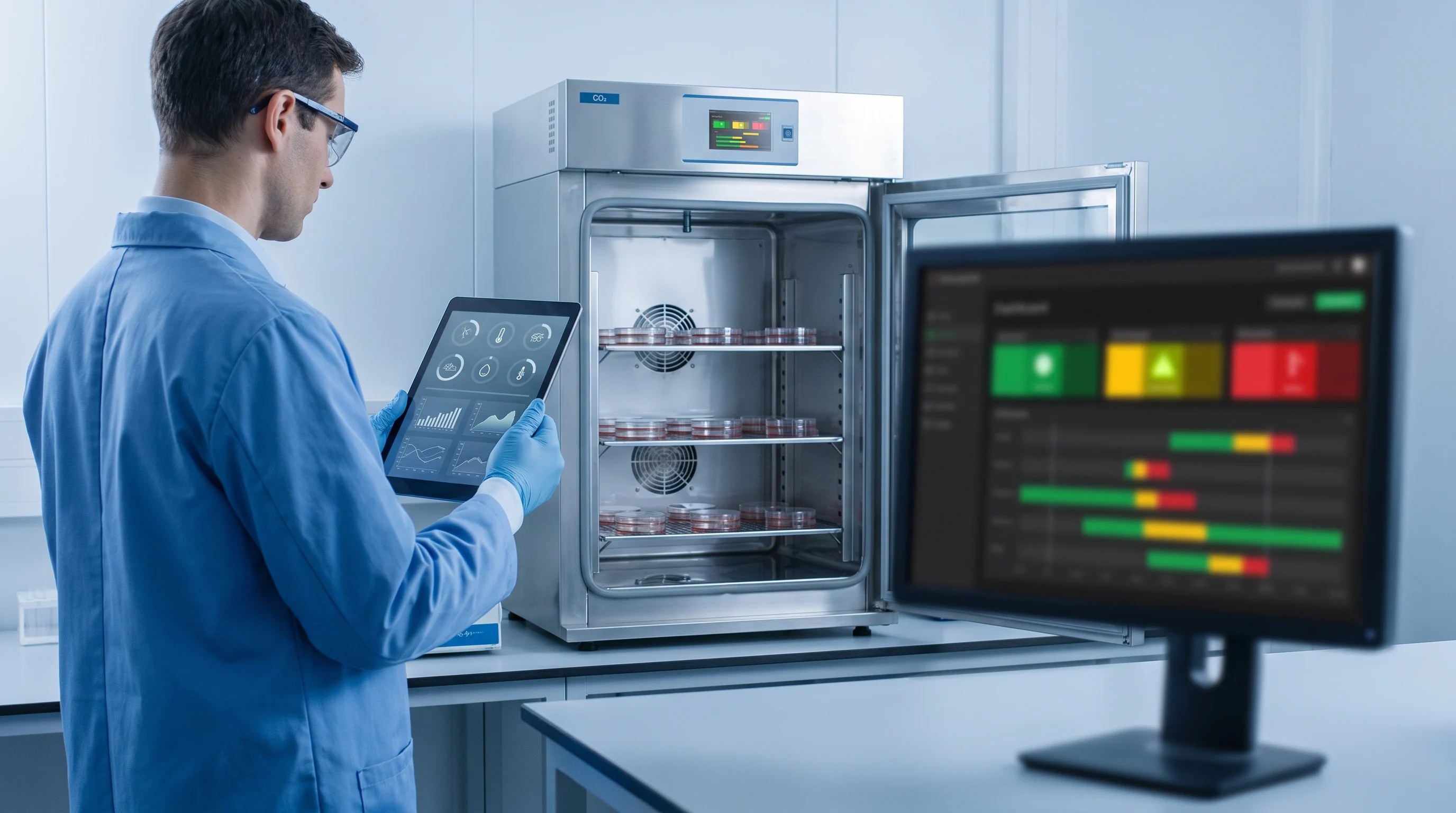
A CO2 alarm proves one narrow fact: the reading at a monitoring point satisfied the configured alarm rule. It does not prove why the condition changed, how the whole incubator behaved, whether a culture was affected, or whether acknowledgement led to a useful response.
The practical unit of analysis is not the alarm. It is the event around it.
An incubator event should let the laboratory answer five questions:
- Which signal moved first?
- How far and for how long did the condition move?
- Did the incubator recover as expected?
- Who verified the condition, and what did that person do?
- Which cultures, processes, or studies required a separate scientific or quality assessment?
This is where CO2, temperature, humidity, door, alarm, response, and calibration records become useful together. Each signal narrows the investigation. None of them should be promoted into a root cause on its own.
Decide what each incubator signal can prove
Start by assigning each signal a job. Otherwise, a team can collect six streams of data and still have no common interpretation.
| Signal | What it can establish | What it cannot establish alone |
|---|---|---|
| CO2 trend | The measured atmosphere at that point changed, remained stable, or recovered | Whether the gas supply, connection, controller, door use, or sensor caused the change |
| Temperature trend | The thermal response before, during, and after the event | Whether CO2 control was lost or a culture was affected |
| Humidity trend, where monitored | Humidification and operating context at the monitoring point | Contamination, biological impact, or a universal acceptable limit |
| Door event | When access began, ended, or recurred | That access caused the full environmental event |
| Alarm and notification record | When a configured rule fired and who was notified | When the condition first began or whether corrective action occurred |
| Acknowledgement and response notes | Who accepted ownership and what was recorded | That the incubator recovered or that affected work remained acceptable |
| Calibration and data-continuity record | The confidence the measurement deserves | That the monitoring point represents every location inside the incubator |
Incorrect interpretation: “The CO2 alarm followed a door opening, so the door opening was the root cause.”
Better interpretation: “A recorded door event preceded the measured CO2 change. We need the event duration, temperature response, recovery shape, operating context, and measurement confidence before assigning a cause.”
That distinction prevents a timestamp correlation from becoming a premature conclusion.
Put the event on one timeline
Incubator investigations become ambiguous when everyone uses the phrase “alarm duration” to mean something different. Preserve five timelines:
- Access timeline: when the door opened, closed, or reopened.
- Condition timeline: when CO2, temperature, or humidity began to move, crossed a limit, and returned.
- Alarm timeline: when persistence logic was satisfied and each notification or escalation was issued.
- Response timeline: when a person acknowledged, verified, escalated, intervened, and documented.
- Recovery timeline: when the reading returned inside its limit and when it stabilized near its prior operating band.
These times will not necessarily match. A persistence delay can make the alarm start later than the measured change. Acknowledgement can happen before anyone inspects the incubator. The alarm can clear while the atmosphere is still settling toward its earlier baseline.
For investigation, place the door events, environmental traces, alarm state, notifications, and response notes on the same clock. If the records cannot be aligned, the team has found a data-quality gap before it has found a root cause.
Read the sequence before naming the cause
The order and shape of signals help select the next check. They do not diagnose the equipment.
| Observed sequence | Working interpretation, not a diagnosis | Evidence to check next |
|---|---|---|
| A door event is followed by coordinated CO2 and temperature movement, then recovery | An access-associated disturbance is plausible | Door-open duration, activity performed, recovery time, recurrence, and approved access practice |
| Comparable access events show progressively slower CO2 recovery | Operating margin or use may have changed | Gas-supply status, connections, controller behaviour, loading, door sealing, and workflow |
| CO2 drifts while temperature and door activity remain stable | A CO2-specific supply, control, or measurement path deserves attention | Supply arrangement, connections, controller record, local indication, and monitoring-device status |
| CO2 and temperature move together without a recorded door event | A shared equipment, utility, or unrecorded operating event is plausible | Incubator status, power or utility history, nearby activity, maintenance, and independent evidence |
| One monitored channel changes abruptly while related process signals remain stable | A measurement or data-path issue is plausible | Calibration status, sensor location, local verification, gaps, timestamps, and communication history |
The wording matters. “Plausible” tells the next responder what to inspect. “Confirmed” closes alternatives. Use the latter only when the evidence supports it.
Recovery is often more informative than the peak
Peak values attract attention because they are easy to compare. Recovery behaviour often carries more operational information.
For each disturbance, preserve:
- the pre-event baseline;
- the rate and direction of change;
- the maximum or minimum reached;
- the time spent outside the applicable limit;
- the time required to return inside the limit;
- the time required to stabilize near the prior operating band; and
- whether a new baseline remained after recovery.
Compare recovery only across genuinely similar events: the same incubator, similar operating state and loading, comparable access duration, consistent monitoring point, and unchanged alarm and sampling configuration. Otherwise, the comparison can manufacture a trend from different conditions.
Illustrative example, not customer data: Two similar access events on the same incubator produce comparable minimum CO2 readings, but the second event takes materially longer to stabilize. That pattern does not prove a gas-supply or controller problem, and it does not establish biological impact. It does justify a focused review of the supply path, control response, door sealing, loading, and access workflow before the slower recovery becomes the new normal.
Failure mode: closing every alarm once the value returns inside the limit. This records the endpoint but discards the question that trend review should answer: is the incubator responding to the same disturbance as it did before?
Treat humidity as context, not a shortcut to biological conclusions
Where humidity is part of the monitoring plan, its trend can help explain humidification state, water-related procedures, maintenance, access, or a broader change in incubator operation. Its relevance depends on the incubator, process, monitoring location, and laboratory procedure.
Humidity should therefore be read alongside CO2, temperature, door, maintenance, and water-management records. A humidity change alone does not establish contamination, culture impact, or an acceptable disposition.
Risky interpretation: “Humidity dropped during the event, so the cultures were compromised.”
Defensible interpretation: “Humidity changed at this monitoring point during the event. The laboratory must determine what that reading represents and whether the cultures or work present require assessment under the applicable procedure.”
Environmental monitoring supplies evidence for that decision; it does not replace the scientific decision.
Separate environmental recovery from culture disposition
One incubator event can require three different decisions:
- Operational decision: Is the incubator back under control, and can it remain in service?
- Scientific or quality decision: Which cultures, samples, processes, or studies were present, and what assessment do their requirements call for?
- System decision: Is this an isolated event, or evidence of a recurring equipment, utility, workflow, alarm, or response problem?
The roles may overlap in a small laboratory, but the questions should not. Restoring CO2 or temperature does not automatically resolve the assessment of work that was present. Conversely, a monitoring alarm does not by itself prove that a culture was harmed.
The assessment should use the laboratory’s defined limits and process knowledge: what was inside, where it was in the workflow, which vessels or media were involved, the possible exposure window, and what the study or quality procedure requires. For a broader evidence chain, use the environmental excursion investigation checklist.
Build an event packet that survives shift change
An incubator event should be reviewable without asking the original responder to reconstruct it from memory. Preserve a compact event packet containing:
- incubator, monitoring point, sensor, and probe identifiers;
- configured CO2, temperature, and humidity limits where applicable;
- sampling interval, persistence rule, and escalation rule;
- door events and environmental traces before, during, and after the condition;
- last stable point, onset, limit crossings, peak or minimum, return, and stabilization;
- alarm, notification, acknowledgement, verification, and intervention timestamps;
- local display or independent verification results, with the source identified;
- calibration status, data gaps, maintenance, gas-supply, and utility context;
- cultures, samples, processes, or studies present during the possible exposure window;
- operational action, scientific or quality assessment, owners, and follow-up; and
- the comparison event or baseline used when the conclusion depends on a trend.
A screenshot of the peak is not an event packet. It removes the onset, sequence, recovery, response, and comparison that make the graph interpretable.
Configure alarms around an action contract
Every alarm rule should have an operational contract:
- the condition the rule is intended to detect;
- the threshold, persistence logic, and sampling interval;
- the role receiving the first notification;
- the acknowledgement window and automatic escalation path;
- the immediate verification or containment action;
- the point at which laboratory operations, facilities, service, or Quality joins; and
- the evidence required before closure.
Do not lengthen a persistence delay merely because routine access produces frequent alarms. That may suppress notifications while leaving the underlying recovery or workflow issue untouched. First determine whether the access practice, threshold rationale, response process, or incubator performance needs to change.
An acknowledgement is also not a resolution state. If the system records only “acknowledged,” the audit trail cannot distinguish between receipt, remote review, physical verification, intervention, and recovery. Alarm-fatigue guidance explains how to keep those states and escalation rules useful.
Calibration and placement define measurement confidence
Calibration, placement, and continuity answer different questions.
- Calibration: Was the device performing within the accepted measurement criteria?
- Placement: What part of the incubator or operating condition does the point represent?
- Continuity: Is the event record complete enough to establish onset, duration, and recovery?
A current calibration does not make a poor location representative. A well-chosen location does not repair missing data. A complete trend from an out-of-tolerance sensor still requires an assessment of how much confidence to place in the historical record.
Connect each monitoring point to its location, intended purpose, calibration result and due date, adjustments or repairs, and any retrospective assessment following an out-of-tolerance finding. The risk-based calibration interval guide expands that decision.
The operating rule
Treat a CO2 incubator event as decision-ready only when the record connects:
- the applicable operating limits and alarm rules;
- trustworthy CO2, temperature, humidity, and door evidence where available;
- a complete condition, alarm, response, and recovery timeline;
- a named owner and documented intervention;
- the cultures, processes, or studies present during the possible exposure window;
- a separate scientific or quality assessment where required; and
- recurrence review or an effectiveness check when corrective action is assigned.
The goal is not to produce more incubator graphs. It is to preserve enough context that laboratory operations, service, facilities, and Quality can reach the right decision without turning correlation into cause.
ATEK’s environmental monitoring platform and CO2, temperature, humidity, and door sensors bring those signals into a shared monitoring record. To review the evidence and response workflow for your incubators, talk to ATEK.