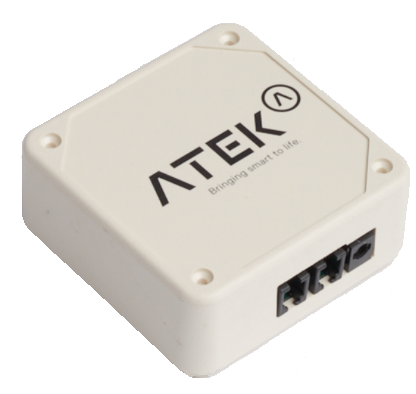
Description
The ATEK transmitter is the electronic component that combines sensor management, power supply and communication with the ATEK platform .
The transmitter is regularly updated remotely at the customer’s premises to create a tailor-made system adapted to the customer’s environment.
The modularity of the transmitter makes it very versatile for connecting sensors of all types.
The behavior of the transmitter is configurable, allowing it to read or transmit sensor readings at specified frequencies.
Specifications
Communication
-
Zigbee
-
WiFi (WPA2 Enterprise and personal)
-
LTE Cellular
-
LoRa
Food
-
External 5 volts, 500mA
-
Internal rechargeable battery 4.2 Volts 3.4Ah
-
Battery life 2 years*
Sensors
-
Digital temperature -40 to 60°C
-
RTD temperature -200 to 150°C
-
Thermistor temperature
-
Ambient temperature humidity
-
CO 2 O 2 incubator (10%)
-
Dry contact
-
Room differential pressure
-
CO2 Circuit Pressure
-
Chemical hood alarm
-
Analog 0-10 Volts or 4-20 mA
Features
Food
The external power supply has a cable length of 3 meters offering the flexibility of reaching a power outlet distant from the equipment. We offer several accessories to maximize the use of external power including NEMA 6-15 converters, extensions, splitter cables and 5 volt PoE converters
Battery
The transmitter’s internal battery is a rechargeable, high-capacity 18650 battery that offers operating autonomy of up to 2 years depending on the configuration. When the battery reaches 20% of its capacity, an audible signal is emitted every 30 seconds. The battery serves as a UPS when the main power is turned off.
Wireless communication
Supported communication technologies are Zigbee, WiFi, Lora and cellular LTE. The transmitter communicates with the ATEK platform bidirectionally to send sensor readings and synchronize configurations with the online platform.
Internal memory
The internal database offers a recording capacity of 6 months of data every 5 minutes.
Module and sensors
The modularity of the transmitter allows it to interface with a multitude of sensors.
Display
The transmitter display is a device that attaches to the transmitter to display probe readings and transmitter status. It presents battery status, wireless signal strength. Its button is used to inhibit alarms locally and on the platform or to force reading and transmission of data.
Buzzer
The buzzer sounds when the button is pressed, the battery is low, a probe has been disconnected, a transmission has failed, or an alert is in progress.
Loss of power
The transmitter must be plugged into an outlet for it to operate. During a power outage, it no longer receives electricity but is supported by the battery and can detect a loss of power. Three causes can appear in this case:
-
a black cable coming out of the box is unplugged
-
the power supply is unplugged
-
The power outlet is no longer powered
Functioning
Startup
- The transmitter checks feature configurations to detect :
-
Modem type and transmission interval
-
Sensor type and reading interval
- Time synchronizes with the network. Important, the network (WiFi, LoRa, Zigbee or LTE) must be functional at startup to synchronize the time, otherwise no data will be recorded until the first synchronization.
Full Power Mode Operation - Powered
-
The default sensor reading interval is 30 seconds.
-
The default transmission interval is 30 seconds.
Low Power Mode Operation - Battery Only
-
The default sensor reading interval is 5 minutes
-
The default transmission interval is 15 minutes
Events
-
External power supply is disconnected
-
A transmission is immediately sent to the server of this change
-
The transmitter starts a 4 hour timer before changing its operation to low power mode
-
-
External power supply is connected
- Transmitter changes to full power mode
-
Button is pressed
- The transmitter takes 10 sensor readings and immediately transmits the data. The button inhibits local alarms for 60 minutes
-
Loss of network connection
- The transmitter saves data in its internal memory every 5 minutes until the network returns where the data is uploaded en masse.
-
Connecting a probe
- The transmitter detects the new probe and automatically synchronizes the calibration parameters with the ATEK platform.
Design
The ATEK transmitter uses a microcontroller whose functionalities have been developed solely by our team in assembly, C and C++.
For the execution of its internal processes, we use a “ Real-Time Operating System ” called FreeRTOS. https://www.freertos.org/
Unlike a microprocessor which comes with an advanced operating system that may come with vulnerabilities, the capabilities of a microcontroller are very limited. It can only run code that has been developed and compiled.
The advantages of a microcontroller are:
-
Intrinsic computer security due to its limited hardware capabilities
-
Reduced energy consumption which allows greater autonomy on batteries
-
Lower cost than a microprocessor
-
Easier to design printed circuit
 ATEK Transmitter - User manual EN v1.9.pdf