ATEK Particulate Matter Sensor
Specifications
1. Measured Numerical Concentration:
-
Particle Size Range: Measures PM1.0, PM2.5, PM4.0 and PM10.
-
The ATEK particle sensor is capable of measuring the numerical concentration of particles in ambient air.
-
The results are given in number of particles per cm³ (particles/cm³) for the detected particle sizes.
2. Measurement Range:
-
0 to 3,000 #/cm³
-
Accuracy:
-
For PM0.5, PM1, and PM2.5:
-
0 to 1,000 #/cm³: ±100 #/cm³
-
1,000 to 3,000 #/cm³: ±10% of the measured value (m.v.)
-
-
For PM4 and PM10:
-
0 to 1,000 #/cm³: ±250 #/cm³
-
1,000 to 3,000 #/cm³: ±25% of the measured value (m.v.)
-
-
-
Long-Term Maximum Drift of Numerical Concentration Accuracy:
-
For 0 to 1,000 #/cm³: ±12.5 #/cm³ per year
For 1,000 to 3,000 #/cm³: ±1.25% of the measured value (m.v.) per year
-
Sensitivity: Detects particles as small as 0.3 µm.
-
Measured Particle Sizes:
-
PM0.5 0.3 to 0.5 μm
-
PM1.0 0.3 to 1.0 μm
-
PM2.5 0.3 to 2.5 μm
-
PM4 0.3 to 4.0 μm
-
PM10 0.3 to 10.0 μm
-
4. Environmental Tolerances:
-
Operating Conditions:
-
Temperature: -10°C to +60°C.
-
Humidity: 0% to 95% RH (without condensation).
-
-
Storage Conditions:
-
Temperature: -40°C to +70°C.
-
Humidity: <95% RH.
-
5. Conversion to particles/m³:
To comply with standards like ISO 14644-1, the concentration in particles/cm³ can be converted to particles/m³:
- Concentration in particles/m³ = Concentration in particles/cm³ × 1,000,000
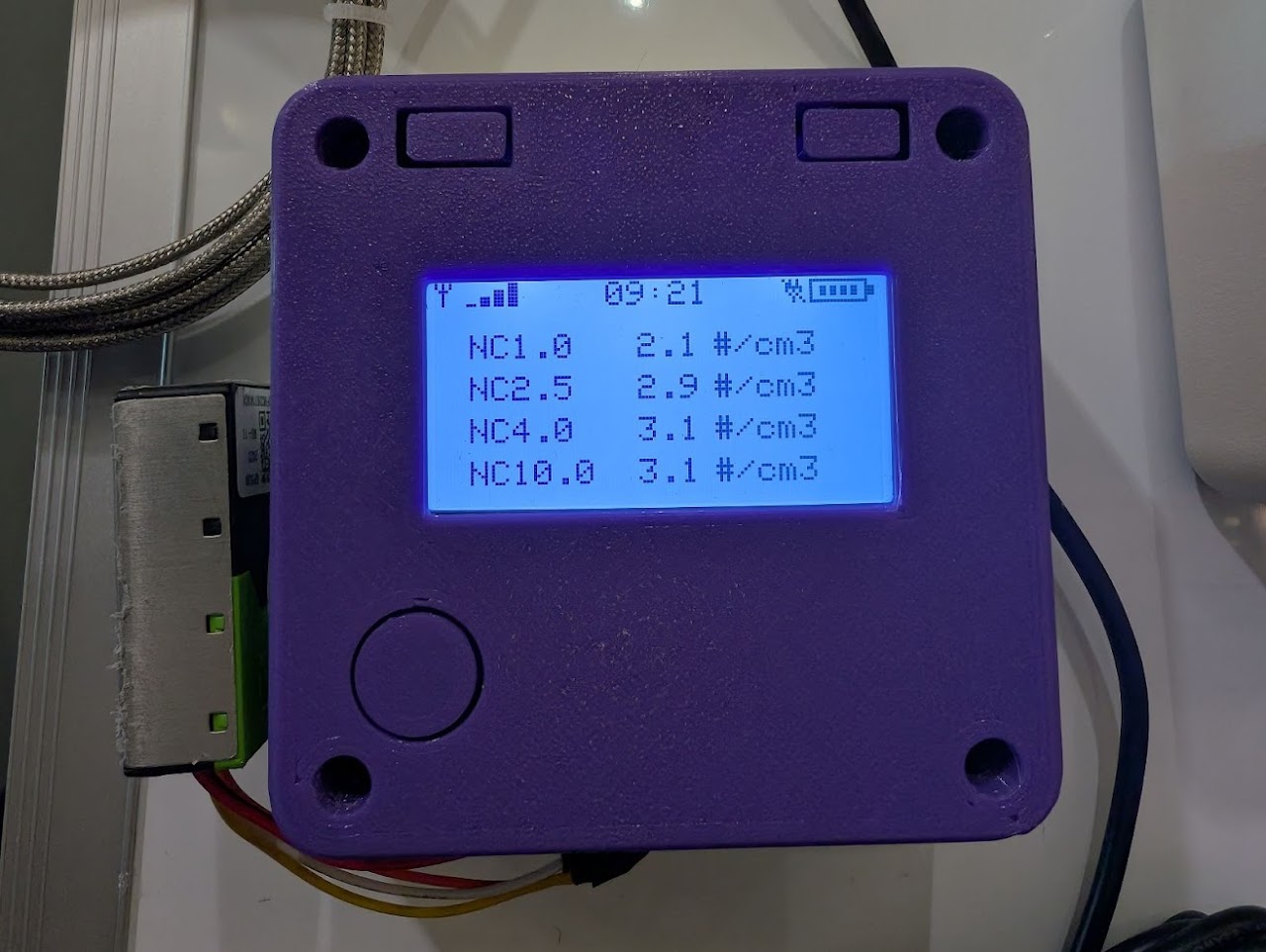
For example, if the sensor indicates 3.1 particles/cm³, that is equivalent to: 3.1 particles/cm³ × 1,000,000 = 3,100,000 particles/m³.
6. Implications:
-
This data is essential for evaluating air cleanliness in controlled environments like cleanrooms.
-
It can be used to verify if the room complies with the specified limits for ISO classes (such as ISO 7 or ISO 8).
-
For ISO 7: The maximum allowed concentration for particles ≥0.5 µm is 352,000 particles/m³. (NC10 < 0.352#/cm³)
-
For ISO 8: The maximum allowed concentration for particles ≥0.5 µm is 3,520,000 particles/m³. (NC10 < 3.52#/cm³)