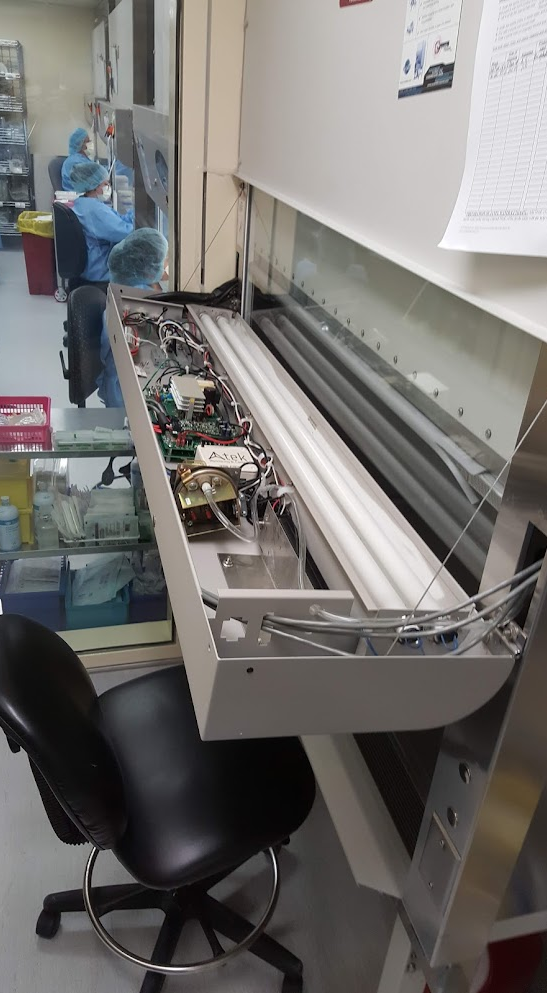
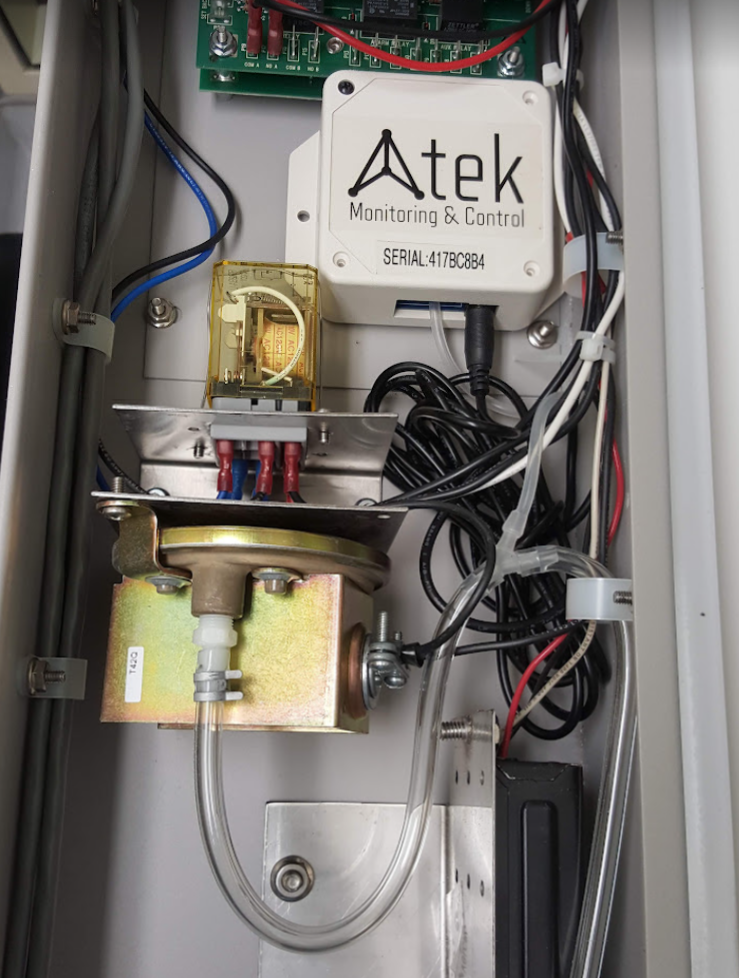
DESCRIPTION
The fume hood monitor is used to notify the user if the hood is not safe to use.
WORKING PRINCIPLES
To have an air flow (velocity), a differential air pressure must be present.
Higher the pressure, higher the air velocity.
CALIBRATION
The fume hood monitor is calibrated for two specific points:
-
with the sash fully open (lowest velocity point) and
-
with the sash fully closed (highest velocity point).
SPECIFICATIONS
Measurement range ±125Pa
Accuracy 0.08 Pa
Span Accuracy 3%
Offset stability <0.05 Pa/year
Buzzer 80 Decibels
Intuitive Display
One button action
Easy calibration process
Easy installation
IN THE BOX
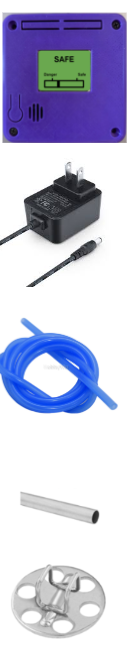
ATEK Transmitter with differential pressure module and display Power supply 2’ silicon tubing 18” aluminum tube Fastening Hardware
DEFINITIONS
Air flow : Flow of air or any other fluid is caused by a pressure differential between two points. Flow will originate from an area of high energy, or pressure, and proceed to area(s) of lower energy or pressure.
Air velocity : Air velocity (distance traveled per unit of time) is most often expressed in feet per minute (FPM). In a hood, we want the air to move fast enough to catch fumes with it and keep the environment safe.
INSTALLATION
-
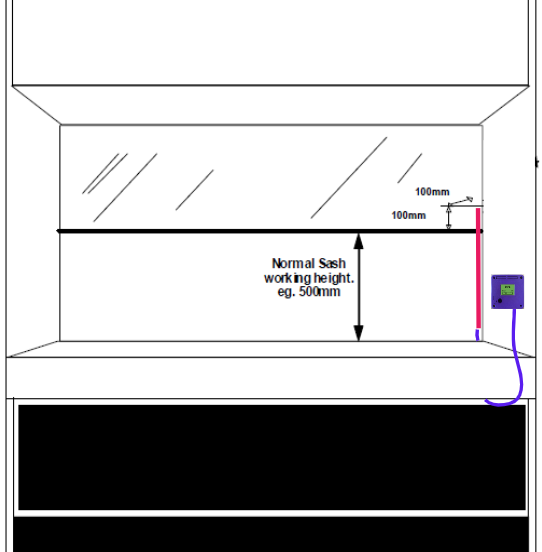
Install the tube mount with Epoxy inside the hood on the wall behind the sash
-
The opening end of the tube must located at 100 mm from the sash at working height
-
Place the transmitter with magnet beside the window
-
Plug the power supply from hood the electric outlet to the transmitter
-
Power On the transmitter
-
Proceed with the calibration process
-
The monitor is ready to use
AIRFLOW MONITOR ARE REQUIRED
Per ANSI Z9.5-2012, Section 8.10:
“All Hoods and exposure control devices shall be equipped with a flow indicator, flow alarm, or face velocity alarm indicator as applicable to alert users to improper exhaust flow.”
Per NFPA 45-2015, Section 7.8.7:
“A measuring device for indicating that the hood airflow remains within safe design limits shall be provided on each chemical fume hood… The measuring device for hood airflow shall be a permanently installed device and shall provide continuous indication to the hood user of adequate airflow and alert inadequate hood airflow by a combination of an audible and visual alarm. Where an audible alarm could compromise the safety of the user or the research, alternative means of alarm shall be considered.”
Per 29 CFR 1910.1450, Appendix A, OSHA Laboratory Standard:
“. . . . each hood shall have a continuous monitoring device to allow convenient confirmation of adequate hood performance before use. If this is not possible, work with substances of unknown toxicity should be avoided or other types of local ventilation devices should be provided… chemical hoods should be maintained, monitored, and routinely tested for proper performance.”
Per Prudent Practices, Section 9.C.2.4:
“Make sure that a continuous performance monitoring device is present, and check it every time the chemical hood is used.”
Per SEFA-1, Section 4.1.10:
“All hoods shall have some type of monitor for indicating face velocity or exhaust flow verification. The monitor can be a simple pressure gage connected to a Pitot tube in the exhaust duct, one of many electronic monitors, or a vaneometer. Regardless of the monitor installed, it should provide clear indication to the hood user whether exhaust flow or face velocity is within design parameters. A ribbon taped to the bottom of the sash is not acceptable.”
RETROFITTING AN EXISTING HOOD
The ATEK pressure transmitter can be installed on the vacuum circuit (pipe) of the hood in order to measure the pressure and deduce the air velocity.
Advantage
-
The measuring point is the same as the manufacturer.
-
Internal and integrated installation, which means less to clean in a sterile area.
Disadvantage
- The transmitter cannot directly alert users of the hood, the audible and visual alarm must come from the hood.