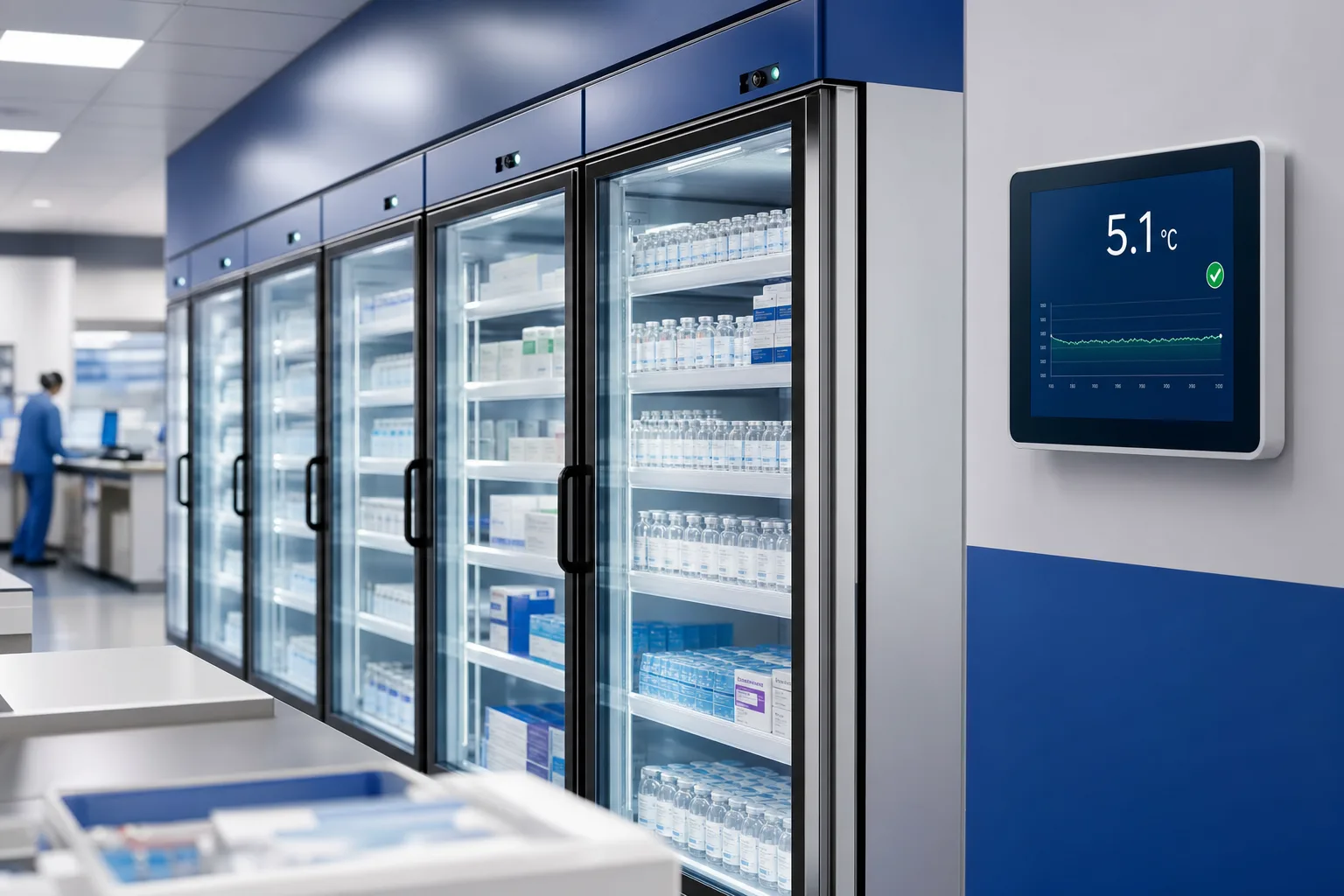
Every province and territory in Canada requires refrigerated vaccines to be held at +2°C to +8°C, monitored continuously with a calibrated device, with any temperature excursion quarantined, documented, and reported before the vaccine is used. That common baseline comes from the Public Health Agency of Canada (PHAC) National Vaccine Storage and Handling Guidelines, which every jurisdiction builds on. Each then adds its own written protocol with local rules on reporting forms, alarm thresholds, and inspections.
If you operate across more than one province, this guide covers what is the same everywhere, where the rules diverge, and how to stay compliant in every jurisdiction at once. Every province and territory is linked below.
Free download: the one-page Canadian Vaccine Cold Chain Compliance Checklist — every province and territory requirement in a printable list.
The national baseline every jurisdiction shares
Whether you store vaccines in Vancouver or Iqaluit, five requirements are constant:
- Temperature range: +2°C to +8°C for refrigerated vaccines (target set point +5°C). Some vaccines are stored frozen instead — at the manufacturer’s freezer range (around -15°C or colder, and ultra-cold for a few products) — so always follow each product’s label.
- Continuous monitoring: a digital data logger with a buffered (glycol) probe, not the fridge’s built-in dial, with minimum/maximum temperatures reviewed at least once each working day.
- Traceable calibration: the monitoring device must carry a valid calibration certificate traceable to a national standard.
- Cold chain break response: an out-of-range excursion means the affected vaccine is isolated, marked “do not use”, kept at +2°C to +8°C, and reported to public health for assessment before it is discarded or administered.
- Documentation and accountability: written procedures, a designated vaccine coordinator (and a backup), staff training, and records ready for audit.
This baseline is set by the PHAC national vaccine storage guidelines. No province or territory asks for less.
What is the same, and what actually varies
The striking thing about Canadian vaccine storage rules is how consistent they are. Daily minimum/maximum recording, a designated vaccine coordinator with a backup, quarantining and reporting any excursion, traceable calibration, and staff training are expected in essentially every province and territory, because they all build on the same PHAC national guidelines. These are shared requirements, not the specialty of one or two provinces.
The genuine differences are narrow and mostly procedural:
- Which form and which authority you report a break to. Manitoba uses a Cold Chain Failure Response Form submitted to Manitoba Health; Quebec reports every breach to regional public health under the PIQ; each province names its own channel.
- Specific equipment thresholds. Alberta, for example, ties laboratory-grade refrigerators and continuous monitoring to sites holding $5,000 or more of vaccine.
- Transport and remote-site provisions. New Brunswick recommends min-max thermometers for in-community transport; the territories (Yukon, NWT, Nunavut) add power-outage planning and safe transport to remote community health centres.
Everything else is common ground. The practical takeaway: if your monitoring satisfies the strictest jurisdiction you operate in, it satisfies them all.
Every province and territory: the requirement directory
| Jurisdiction | Vaccine storage guideline |
|---|---|
| British Columbia (BCCDC) | BCCDC vaccine cold chain requirements |
| Alberta | Alberta vaccine storage policy |
| Saskatchewan | Saskatchewan vaccine storage guidelines |
| Manitoba | Manitoba cold chain protocol |
| Ontario | Ontario vaccine storage guidelines |
| Quebec (MSSS) | Quebec PIQ vaccine standards |
| New Brunswick | New Brunswick vaccine storage policy |
| Nova Scotia | Nova Scotia vaccine storage guidelines |
| Yukon | Yukon vaccine storage standards |
| Northwest Territories | NWT vaccine storage standards |
| Nunavut | Nunavut vaccine storage guidelines |
| National | PHAC national vaccine storage guidelines |
What Canadian providers should look for
For a Canadian pharmacy, clinic, or health network, compliance is the starting point, not the finish line. The monitoring system also has to fit how Canadian healthcare actually runs:
- Compliant first. Built to the PHAC baseline and every provincial protocol: continuous monitoring, traceable calibration, min/max, breach documentation, audit-ready records.
- Data hosted in Canada. Health data stays on Canadian soil, which matters for public health networks and privacy expectations. A US-hosted platform is a hard sell for many Canadian buyers.
- Bilingual support, French and English, 24/7. An overnight excursion in Quebec or New Brunswick reaches a real person in the language your team works in, any hour.
- Reliable and responsive. A guaranteed fast human response when a fridge fails, not an email into a queue, because a lost vaccine fridge is a lost day of immunizations.
ATEK is built to exactly this: continuous wireless monitoring of each vaccine refrigerator with alerts at the +2°C and +8°C boundaries by SMS, email, and automated phone call; calibration in-house by an A2LA-accredited (ISO/IEC 17025) laboratory; Canadian-hosted data; and 24/7 bilingual support from a Montreal-based team. Minimum/maximum and full history export for PHAC and provincial documentation, so one platform stays audit-ready in every jurisdiction.
For multi-site or multi-province networks, one platform documenting to the strictest standard keeps every location consistent. See the vaccine and cold chain monitoring solution, or if you are comparing vendors, the ATEK vs Sensaphone comparison.
Managing vaccine storage in more than one province? Request a demo to see continuous monitoring, alerting, and audit-ready records that satisfy every Canadian jurisdiction.
Frequently asked questions
What temperature must vaccines be stored at in Canada? +2°C to +8°C for refrigerated vaccines in every province and territory, with +5°C as the typical set point. Some vaccines are stored frozen instead, at the manufacturer’s freezer range — always follow the product label.
Do all provinces follow the same vaccine storage rules? They share the PHAC national baseline (+2°C to +8°C, continuous calibrated monitoring, breach reporting, documentation), but each province and territory publishes its own protocol with local rules on forms, alarm thresholds, and inspections.
Is a fridge thermometer enough anywhere in Canada? No. Every jurisdiction expects a continuous digital data logger with a buffered probe and a traceable calibration certificate, not the fridge’s built-in display.
How do I stay compliant across multiple provinces? Monitor to the strictest requirement among the jurisdictions you operate in. Continuous monitoring, traceable calibration, and exportable min/max records satisfy every provincial and territorial standard at once.
Where is the monitoring data stored? For Canadian healthcare providers, look for a platform that hosts data in Canada. ATEK keeps monitoring data on Canadian soil, which matters for public health networks and privacy expectations.
Is support available in French? Yes. ATEK provides bilingual (French and English) support 24/7 from a Montreal-based team, so an overnight excursion in any province reaches a real person in your team’s language.
Ready to standardize vaccine monitoring across Canada? Contact ATEK to discuss your sites, or explore the vaccine monitoring solution to see how one platform covers every jurisdiction.